



|
|
|
|
|
|
| |
Home Page Site Search Sights & Activities Localities • Places Good Travel Faqs Sicily's Top 12 Hotels • Planning Maps of Sicily Weather • Climate Nature • History • People Food • Wine • Dining Arts • Literature • Culture Monthly Magazine Sicilian Identity Sicily Links Contact • Follow
|
Modern Sicilian History & Society While historians regard a few centuries of the Middle Ages as the high point of Sicilian history, the last five hundred years are the key to understanding the complexities of the Sicily we see today...
• The Modern Era (1500-present) The Modern Era
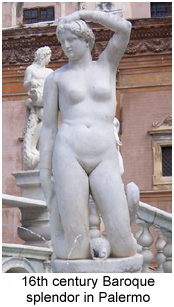
Sicily as a 'Colony' While northern-Italian cities like Venice, Milan and Genoa thrived as what were effectively independent states, southern Italy, with its government centralised in 'capital' cities like Naples and Palermo (and dynastic rule from abroad) languished by comparison. A popular historical theory suggests this as the principal cause for the differences in mentality between Italy's northerners and southerners, and hence the very different economies of the two regions. In short, the northerners came to view themselves as citizens who believed they could determine their own collective destiny, while the southerners thought of themselves as the neglected subjects that they were. Sadly, this problem has not been relegated to the realm of history. To this day, the majority of Sicilians look to the 'welfare state' or some kind of 'sponsor' who has replaced the padrone (master) who meted out miserable wages to poor peasants. A firm monarchical hand may have worked during Sicily's glorious Middle Ages, but by the sixteenth century the Crown could function efficiently only in the presence of substantial reforms, and in the Kingdom of Sicily under foreign rule these reforms never arrived. What did arrive were ships carrying Spanish viceroys, but Sicily was never easy to govern. Corruption was endemic, especially among the ruling classes. The nobility was especially greedy, not only for money, power and privileges but also for ever more grandiose titles. Until the sixteenth century most feudatories - great and small - were signori (lords), barons, and counts (a county might contain several baronies). Now the nobles craved ever greater titles of nobility: prince, duke, marquis. Not all nobles were created equal, and the more important landholders wanted to distinguish themselves from those who more recently had become barons through the purchase of land which happened to be classified as "feudal," something possible until the abolition of feudalism in 1812. In practice, the more important aristocrats had a monopoly on important offices, to which they were appointed by Madrid. Currying favour with the viceroy became an aristocratic obsession. They used the frequent parliamentary sessions to negotiate with the crown. The kings, for their part, were content to placate the nobles with frequent compromises. Dealing with the general populace was not always so simple. In 1519 Charles V became king as well as Holy Roman Emperor, inheriting vast parts of Europe and the Americas. To this remarkable monarch Sicily was but one piece of an expansive empire, but not an insignificant one. To combat the Barbary pirates he ordered walls built around Sicily's coastal cities beginning in 1535, and ceded Malta to the Knights Hospitaller to serve as a bulwark against the Ottoman Turks. Fleeing the knights, the brilliant rogue Caravaggio ended up in Sicily, where he executed some commissions in 1609. Catastrophic Century Palermo was struck by an outbreak of Plague in 1624. It subsided when a hunter found what are believed to be the bones of Saint Rosalie on Mount Pellegrino overlooking the city. In 1638, during the reign of Philip IV (Hapsburg) of Spain, the crown levied a "head tax" to be paid by the feudatories of Sicily's feudal towns and the citizens of its demesnial cities to defray the cost of the Hapsburgs' Thirty Year War. In his History of Sicily, Denis Mack Smith wrote that, "despite the fact that many aristocratic families were undeniably living beyond their means, it is evident that some people still had plenty of money. More and more the towns were forced to pay their taxes by borrowing, but at least there were some people to borrow from." There was occasional widespread hunger verging on famine. In 1643, the grain harvest was terrible. When a ship arrived at Siracusa loaded with grain the people commandeered it and seized the cargo without bothering to grind it into flower, instead preparing cuccìa, a pudding of wheat berries. As a statue of Saint Lucy was displayed at Siracusa, the tradition of serving this confection, or arancini, was born. On her feast day, 13 December, ground flour products are not consumed. Some disasters were natural rather than economic. An eruption of Etna in 1669 seriously damaged several towns. Poor harvests and, more importantly, a long economic recession after 1671 had a particularly serious effect in Messina, where riots broke out in 1674 and lasted four tumultuous years. Unlike other rebellions of the period, this one was essentially political. A major earthquake in 1693 destroyed much of southeatern Sicily. The new buildings erected in Noto and Ragusa were part of the new Sicilian Baroque style. Then a catastrophic eruption of Etna in 1699 reached Catania, effectively extending its coastline into the Ionian Sea. The seventeenth century was indeed a calamitous one for the Sicilians. Contested Island With the death of Charles II in 1700, his succession passed from the Hapsburgs to the Bourbons, but this idea was contested by other European powers which did not wish to see Spain and France united under a single Bourbon "super monarch." For the next fourteen years, Sicily was dragged into the War of the Spanish Succession and in the end came through it unscathed except for a change in its dynasty. The island's destiny was tied to its value as a bargaining chip.
We may gauge the power of the landed classes by considering that the 1748 land census (rivello) indicates approximately 780,000 people living in feudal towns under more-or-less direct baronial authority while the minority of Sicilians, numbering some 400,000, lived in royal or 'demesnial' localities. Bourbons of Naples In 1782 the Inquisition was finally suppressed in Sicily on the orders of the viceroy, the marquis Domenico Caracciolo - a reformer who attempted to rein in the zealous aristocrats and bring more honest government to the island. This was facilitated by the fact that the Jesuits, who were among the Holy Office's most fervent advocates, had already been expelled from Sicily in 1767, to be reinstated in the next century but without their former wealth. In Caracciolo's opinion, Sicily was, "inhabited only by oppressors or the oppressed." He found it especially horrible that, given the power of the aristocrats, two hundred landholders had "swallowed up one and a half million" people who lived on the island. But we should have no illusions. Censorship of every progressive and 'foreign' idea was a fact of life. Neither the Enlightenment or the Industrial Revolution made their way to Sicily, but when Goethe visited in 1787 as part of his Grand Tour of Europe, he liked what he saw. Charles' son and successor, Ferdinand I, found himself in Sicily during the early years of the nineteenth century, but not by choice. The King and his family were forced to flee Naples during the Napoleonic occupation, when British troops occupied Sicily, anticipating a French invasion. Palermo-born Cagliostro, an alchemist and 'occultist' claiming to be a count, was arested by Paris police in 1785 and sent to Papal authorities to be tried as an impostor and heretic. In death he became something of a folk hero. Napoleon captured Malta in 1798 en route to Egypt, and kicked out the Knights of Malta. The incident is little more than a footnote to history, but Malta and Gozo had been Sicilian dependencies since Norman times. When the French were finally defeated, Ferdinand protested the islands' possession by Britain, but to no avail. During the Second World War, an ignorant Benito Mussolini was to claim that Maltese, an Arabic language, was a "dialect of Italian" and bomb the islands relentlessly. Ferdinand's's grandson, who would later reign as Ferdinand II, was born at Palermo during this period, but the monarch and his son, Francis (the future King Francis I) spent most of their time at the splendid Chinese Villa, set in a park at the foot of Mount Pellegrino, or at the Royal Hunting Lodge at Ficuzza, an estate in the Sicanian Mountains. In 1810 Francis' son, the future Ferdinand II, was born in Palermo, the first king born on the island in centuries. In 1812, under British influence, Ferdinand signed the decree abolishing feudalism, thus abrogating the last land rights of the nobility. In consolation, he established a parliamentary chamber of peers consisting of the more important nobles, and granted what would turn out to be an enlightened but short-lived Constitution. Though cut off from Naples, Sicily was enjoying an economic boom of sorts with the mining of sulfur. With the expulsion of the French and the accords of the Congress of Vienna (1814-1815), Ferdinand returned to Naples. In 1816, he amalgamated the Neapolitan and Sicilian realms into one state, forming the Kingdom of the Two Sicilies, Italy's most prosperous state. Lacking the benefits of the Industrial Revolution, Sicily was relatively underdeveloped (some say it still is), though no more so than most other parts of Italy. A few Sicilians proved exceptional. The Florio family was such an exception, investing in tuna canning plants, steamships and an independent newspaper. Age of Risorgimento The seeds of dissent had been sown, however, and when a band of mostly Piedmontese troops led by Giuseppe Garibaldi landed in Sicily in 1860, the pious young King Francis II, son of the late Ferdinand II, proved himself ill prepared to meet a military challenge, even though he had Italy's largest army at his disposal. Sadly, a number of high military officers had already been bribed by the Piedmontese, while others saw no reason to fight for a King who seemed reluctant to act. Weapons had already been smuggled into Sicily to support the conquest, and the British fleet commanded by Admiral Rodney Mundy prevented the Sicilian ships from attacking Garibaldi's vessels at Marsala, the British having already decided that their Sicilian sulphur monopoly might more secure under a new dynasty. Additional support soon arrived from Piedmont. (Today's most sophisticated historians - in Italy and abroad - seriously question the way the Risorgimento came about, and for this complex subject the reader is referred to some recent, insightful histories of the Italian unification movement.) Sicily in the Kingdom of Italy The rest of the Kingdom had fallen by March 1861, though there were pockets of armed resistance by partisans in the mountains of the mainland. There was never any declaration of war, and a false referendum (with an alleged majority of almost 99%) confirmed Francis' cousin, King Victor Emanuel II of Sardinia, as "King of Italy." (Francis himself was exiled and died in Trent, then part of Austria, in 1894, survived by his wife Maria Sofia of Bavaria; his descendants were illegally exiled until the 1930s.) A great deal of historical revisionism sought to paint the new unitary state in its best light while disparaging Sicily's previous one. By 1900, most Italians realized this was a self-serving deception (some good histories are listed in this page's book section) and many were emigrating from Italy.
In September 1866, an anti-Savoy revolt broke out in Palermo but was ruthlessly put down within a week. By December of that year, tens of thousands of Piedmontese troops had occupied Sicily to prop up the new regime. Most of the land holdings of the Church were gradually being confiscated by the new government, and with them numerous schools, which were closed. Most Sicilian schools had been administered by the monastic orders, and they were not immediately substituted by state institutions. Francesco Crispi actually refused to support a bill that would have established public schools to replace the Catholic ones which had closed. This meant that illiteracy became more widespread, though previously its prevalence in Sicily had been no higher than in most other parts of Italy. Anthropologist and folklorist Giuseppe Pitré was the first scholar to seriously study the customs, language and plight of the poorer classes. Often, however, his descriptions failed to trascend caricatures like the downtrodden peasant wearing a coppola cap. Yet a genuine, if eclectic, Sicilian Identity exists. Today one might compare Sicily to other European regions which were formerly sovereign kingdoms but are now semi-autonomous. Catalonia, Bavaria and Scotland come to mind. The Kingdom of Italy, a country woven of a patchwork of pre-unitary nations, was in fact a police state in expansionist mode. Press censorship glorified the new regime, and military conscription provided troops for its foreign adventures. East Africa, Libya and even Rhodes suffered Italian incursions. Fascism was - if anything - worse than what existed until 1922. The Eve of Fascism The decades following 1860 witnessed Sicily's slow economic decline as important new industries gradually emerged not in the South but in the North. Some of this was economic happenstance, but much was the result of punitive taxation and other national economic policies detrimental to the South which discouraged industry there. Until the 1860s, the Kingdom of the Two Sicilies (i.e. Naples and Sicily) was clearly the largest, wealthiest and most industrialized of the various Italian states. While Italian immigration prior to about 1870 had been primarily from the poorer northern regions, henceforth it was to be from the increasingly poorer South. Between 1890 and 1930, millions of southerners (as they were now called) left for the Americas, spawning a kind of diaspora, while in Italy the popolino forms a permanent underclass. Sicily was still a stop on the Grand Tour, and Wagner arrived for a lengthy stay in 1881. Despite the terrible economy, Sicily produced her share of scientists, such as Stanislao Canizzaro, who expanded the science departments of the generally mediocre University of Palermo, but the island could hardly be considered a distinguished center of learning - nor is it today, when nepotism and cronyism are rife. Late in 1893, protests by the Fasci Siciliani, collectives of thousands farmers and sulphur miners, turned violent as Francesco Crispi, the corrupt (and bigamist) prime minister, suppressed them with force. Crispi sided with the wealthy landholders against the protesters, who were sentenced, and in some cases summarily executed, without trials - just like the Bourbonists during the 1860s. Laws followed severely limiting freedom of the press and free association (meetings), confirming Italy as a de facto police state. With the same revisionist brush it used to paint the "evil" Bourbons deposed in 1860, the Kingdom of Italy depicted the men of the Fasci as treasonous socialists, communists and anarchists seeking to overthrow the monarchy; in fact many were devout Catholics and monarchists. Foreign failures like the invasion of Ethiopia, ending in the ill-fated Battle of Adwa in 1896, and then the attempted colonization of Libya, were serious blows to Italian pride. An earthquake and tsunami destroyed most of Messina in 1908, killing around a hundred thousand residents (two-thirds of the population); most of the survivors were still living in 'temporary' huts when the Allies arrived in 1943. That the government was completely ill-prepared to confront the disaster shocked international opinion, but by now the world had learned to take the men of the new Italy with a few grains of salt. Gentlemen, Citizens and Votes The traditional concept of noblesse oblige thus found its modern expression in the idea that rank carries obligations. But in Italy few noblemen were truly noble men. Italy's king and his ministers made no pretension at being gentlemen in this enlightened sense, and neither did the 'robber barons' who constituted the Italian aristocracy. Whereas in England a man's success might earn him his passage into a gentleman's club, in Sicily men like the Florios were viewed with suspicion or even disparaged - though they might be recognised with a knighthood. By 1900, when Britons and Americans were looking to their cautiously-progressive aristocracies as models of social behaviour and philanthropy (even John D. Rockefeller embraced this 'new beneficence'), in Sicily, where the aristocrats were bent on controlling the poorer classes, there was no such model to emulate. To this day charities are poorly supported in Italy except for a few sponsored by the Catholic Church, and the social consciousness of Italians as a whole is sorely lacking. Sicily's social growth has been stunted, creating a climate of excessive materialism and a dearth of altruism as people in Palermo and Catania litter the streets and ignore the plight of their fellow citizens. There's an old Sicilian saying: "If your neighbour's house is on fire, fetch water to save your own." The problem was aggravated by the fact that so few Italians were permitted to vote until the second decade of the twentieth century, and for this reason most people were, in effect, second-class citizens in their own country. In England, the secret ballot had been used since 1872, with universal male suffrage for those of at least twenty-one years of age. In the Kingdom of Italy a law passed in 1882 gave the vote to literate males of at least twenty-one years of age who could demonstrate a certain taxable income. As the great majority of Italians were poor and - compared to Britons - most were illiterate, little changed with this policy: only around forty-eight thousand Sicilians (out of a general population of some three million) could vote. Something approaching universal male suffrage arrived three decades later, in 1912, for all literate men of at least twenty-one years of age, and illiterate men of at least thirty years of age regardless of wealth. Seven years later the vote was extended all males who were at least twenty-one, and veterans of the First World War regardless of age. Women in Italy voted for the first time in 1946. The depth of the upper classes' disdain for the common folk was reflected in the fact that by 1910 Palermo boasted several of the most opulent opera houses of Europe, yet the growing city lacked a public hospital. In that year the parliamentary Lorenzoni Report described a Sicily that remained economically backward while the north was being industrialised. There were also social aspects to the problem, apart from illiteracy among most adults. Most marital engagements were still "arranged," or at least subject to parental approval, and outside the upper classes wives were effectively "cloistered." During the middle of the day a woman might go unaccompanied to the town's communal well for water, or off to work in the wheat fields, but the idea of further freedom was virtually unthinkable. The "rustic engagements" among the popolino are twenty-first century vestiges of such habits. In Italy in 1900 most people tolerated the monarchy, for they had never known anything else, but they despised the aristocracy. No wonder, then, that Italian immigrants in the United States enthusiastically embraced their adopted nation with so little nostalgia for the political ways of the country they had left. People emigrate for a reason, and in Sicily that reason was usually poverty or, in the cases of wealthier emigrés, deep resentment of the government. Fortunately for the Savoys, Italy was easier to control than Russia was for the Romanovs, but the seeds of dissent were being sown in Italy, as elsewhere. In 1922 an Italian socialist movement altered the course of events. Fascist Period Fascism's atrocious foreign policy led to Italy's becoming the first country ever cited by the United Nations for crimes against humanity (in connection with the invasion of Ethiopia). At home, the government disgraced the brilliant Arctic explorer Umberto Nobile, who left for America. (Today, most Italian high school students don't know that the second man to fly over the North Pole was an Italian.) Disgusted with Fascism, the gifted conductor Arturo Toscanini emigrated, choosing to live in New York. The racist laws prohibiting Jewish Italians from holding teaching jobs or government posts prompted Enrico Fermi, whose wife was Jewish, to emigrate, followed by a lesser-known Jewish Italian, Emilio Segré, the Nobel laureate who taught physics at the University of Palermo, where he discovered the first artificially produced element, technetium (Tc), in 1937. Both worked on the Manhattan Project. The activist Luigi Sturzo left Sicily. A number of citizens who remained in Sicily actively opposed Fascism, and at great personal risk; the writer Vitaliano Brancati was an outspoken opponent, while Luigi Pirandello was an advocate of the regime, and owed his Nobel Prize for Literature, at least in part, to Mussolini's coercive efforts with several members of the Nobel Foundation. Fascist land and agricultural policies were fickle. In its early years the regime supported the rights of smallholders, then shifted to the side of the traditional owners of the large estates ('latifondi') before again changing its position to favour the poorer farmers. Second World War It wasn't only Allied troops who perished. Though thousands of Sicilians had lost their lives, either during the bombardments or in combat, the Allied victors were viewed as a benevolent force and warmly embraced by the population. They immediately set about the task of reorganization. Political prisoners were freed from jail, journalists were allowed free expression and, most importantly for the average citizen, food was distributed. Despite Fascist propaganda condemning Allied nations such as the US and UK as evil societies, thousands of Italians found homes in those countries after the war. This included, ironically, many men who had been prisoners of war in Allied countries, where they experienced living conditions superior to those which then existed in Italy. The last few generations of Italians are blissfully ignorant about Fascism and World War II because the Italian schools teach very little about these unpleasant topics in order to avoid "controversy" at home, emanating from students' nonagenarian grandparents who may have supported Mussolini. (It would be distasteful if nonno or nonna contradicted the teacher.) In retrospect, it is amazing how rapidly any sense of Italian nationalism - such as it was - crumbled with the collapse of Fascism and Italy's disgraceful military defeat. In Sicily there was even a separatist movement. In 1946 the King of Italy, Umberto II, signed the decree establishing the semi-autonomous Sicilian Region. Italian Republic Following much unrest, including the massacre of eleven people during a protest at Piana degli Albanesi in 1947, a law passed in 1950 finally broke the monopoly of the major landholders by prohibiting the possession of more than 300 hectares of arable land by a single owner. Subsequent laws established that an estate - land as well as buildings - could not be transmitted to a designated heir but would have to be inherited equally by all the testator's children, female as well as male. This explains the size of Sicilian farms and also the complex ownership of the stately homes of the aristocracy. Oil was discovered around Ragusa in 1953 and near Gela a few years later. This has not saved the Sicilian economy or even helped it very much. The oil industries led to only a few thousand jobs, while the ugly refinery at Gela disfigured the land around the chief archeological site. Sicily was generally backward, but in truth the rest of Italy wasn't much more advanced; it was all relative. In Piedmont, the Savoys' home region, there were more factories, but women there still waded barefoot into flooded paddy fields to cultivate rice (the word mondina described them). Until the arrival of the Allies in 1943 Sicilians died of malaria. The vaccine was brought by the Americans. During the 1950s such modern inventions as refrigerators were slowly introduced; the first models sold widely in Italy were American, so the trade name Frigidaire came into general use as a common noun before the Italian frigorifero. Today economic growth is sluggish, as ever, and chronic unemployment (there is also much underemployment) hovers around twenty-six percent. Industries which could employ thousands have not developed in Sicily. There's a ship-building yard at Palermo but production is not what it used to be. The FIAT automotive-parts plant at Termini Imerese is closing. A few foreign high-technology firms have plants around Catania. Food exports (mineral water, wine, olive oil) have increased since 1990, and so has tourism, but they are not enough to sustain even a small part of the Sicilian economy, and there are few firms willing to come to Sicily to contend with inordinately high labour costs, corrupt politicians and greedy mafiosi when they can set up and operate their businesses far more efficiently in eastern Europe. In 1968 an earthquake destroyed several localities in the Belice Valley in Sicily's western region, turning them into ghost towns. The government was no better prepared for this disaster than it was for the earthquake that levelled Messina six decades earlier.
Unfortunately, Sicilians still do not take enough pride in their cities to keep them clean. This is rooted in the centuries-old mentality of regarding anything beyond the door of one's own home the property of the padrone (master) and therefore unimportant. Public efforts to counter this quasi-medieval 'slave mentality' have thus far met with failure. In the United States the Keep America Beautiful campaign of the 1960s was effective because Americans really did consider their nation an extension of themselves, something which has not yet entered the minds of most people here in Sicily. While Sicily has a small but thriving private-sector economy of shopkeepers, vintners, hoteliers and restaurateurs, the typical Sicilian seeks an easy public-sector job for life from the padrone, with long vacations and perks like a free house and free tickets to football matches. Yet mediocrity is the rule, as fewer books are sold (per capita) in Palermo than in any other major Italian city while the drop-out rate at the infamous University of Palermo is fifty-four percent. Whatever the historical roots of these attitudes may be, it is no longer credible to blame them on the aristocracy, the northerners, the Savoys or the political establishment. An inconvenient fact that the guide books and travel websites won't mention is the huge underclass (the so-called "popolino") that inhabits Sicily's larger cities. They are tainted by the lowest level of education in Europe. There is no sign of hope in sight for these successors to the island's illiterate peasant class. The age of the padroni is long past. Serious as these problems are, Sicilian society has been spared the worst effects of certain social ills that plague some other societies. Alcoholism, for example, is virtually unknown in Sicily while its frequency is increasing in northern Italy. Unwed teenage pregnancies, though on the increase, are quite rare in Sicily. Public prostitution is not as commonplace in Palermo and Catania as it is in Rome and Milan. The use of narcotics is statistically far rarer in Sicily than in Lombardy. Sicily is home to foreign immigrants from Asia and Africa, more welcome here than in Turin or Milan. The standard of living improved during the post-war years, when the uncontrolled construction boom of the 1960s transformed cities like Palermo and Catania into vast concrete jungles. But funds sent under the Marshall Plan to rebuild the parts of Palermo destroyed by Allied bombing were misappropriated, and problems with organized crime persist today. Visitors often ask why, in stark contrast to its historical areas, the newest sections of Palermo are so plain. Architectural evolution aside, the main reason is that during the 1960s and 1970s the officials responsible for issuing building permits actually sold them (illegally, of course) to unsavory investors, with little regard for the kind of urban planning that results in pleasant parks and attractive streets. Old Palermo was planned by kings and aristocrats, New Palermo was built or 'raped' by mafiosi and bureaucrats. The Mafia never rests. The 1990s saw its violent reprisals against the government, and the murders of judges Giovanni Falcone and Paolo Borsellino, for whom Palermo's airport is named. More recently, however, criminal kingpins such as Bernardo Provenzano have been captured. Historical preservation is once again an important priority for at least some Sicilians, and serious efforts are being made to save the island's unique patrimony. This broad cultural movement's goals focus not only on obvious assets like buildings and other monuments, but less tangible ones like the local language and pre-unification regional history (especially a more balanced consideration of the period from 1700 to 1860). Sicily's officially-resident population is around 5.3 million. Its growth has been constant: 1.2 million in 1748, 2.6 million in 1870, 3 million in 1880, 3.8 million in 1910, 4 million in 1936, 4.7 million in 1960, 5 million in 1990. The provinces of Palermo and Catania each have over a million residents. At least a few Sicilians are keenly aware of their island's ancient and medieval past. Ironically, most Sicilians born after 1940 know little of the historical events which occurred in their nation after 1920, since these are not taught in great detail in most Italian schools. Despite a certain degree of political autonomy, government in Sicily seems inefficient (even corrupt) to an extent far worse than that of northern Italy. This won't spoil your trip, but it results in poor traffic control and less than efficient public services. Bread and Circuses: The Welfare State Public money, much of it drawn from European Union development programmes for "poor" regions like Sicily, is squandered by overpaid bureaucrats. The infamous Agenda 2000 programme has become the epitome of this kind of political corruption, characterised by mismanagement and nepotism. In 2009 it was revealed that even funds generated through ticket sales at publicly-administered historical sites were not properly accounted for. For the great majority of Sicilians daily life is difficult. Public services are poorly managed. Traffic in the cities is horrendous; money designated for proper underground trains in central Palermo and Catania has never been utilised. Things like public transportation and healthcare are generally mediocre and sexism normal - though few Sicilian women bother to complain about the latter. In 2008, when Palermo's bus company hired its first female drivers, somebody observed that Sicilian women could finally drive buses while American women had been piloting the space shuttle for years. The chronic trash collection problems are especially distasteful because they reflect a complete breakdown in efficiency. One of the best contemporary descriptions of life in Italy, warts and all, will be found in Tobias Jones' insightful and revealing book, The Dark Heart of Italy, first published in 2003. Customs and Traditions Most stores and businesses are closed from 1 to 4 in the afternoon. Around 5, activity increases in the main piazzas and streets as people take a passeggiata (stroll) to shop, enjoy a pastry, or just meet friends. Sunday afternoons are usually dedicated to the same kind of activities, though most shops are closed. Milestones like first communions and weddings take on a momentous tone in Sicily, where family life is still very important. Family History The Sicilian Language Not until the time of Ciullo of Alcamo was there a true Sicilian language based on the Latin Vulgate introduced into Sicily by Norman and Italian clergy. Until then, Sicily's Arabs spoke Siculo-Arabic (similar to modern Maltese), while others spoke Byzantine-Greek, Norman-French or other tongues. Like many languages of countries amalgamated with their neighbors over time (Welsh, Gaelic and Provençal come to mind), Sicilian gradually fell into disuse among the aristocrats and literate classes, becoming the vernacular tongue of the "popolino," as the masses were called by the nobility. By the seventeenth century, just as the greatest aristocrats of Scotland learned English at home, Sicily's aristocratic classes learned Tuscan, though some nobles necessarily spoke Sicilian in communication with the employees who managed their country estates. Italy's royals spoke Tuscan Italian and formal French, but it is true that the Savoys spoke Piedmontese within their family at their court at Turin, while the Bourbons of Naples spoke Neapolitan as their mother tongue. Italian may be said to have supplanted Sicilian as the spoken language of most of today's Sicilians, most of whom are educated with little practical knowledge of Sicilian, considered little more than the "vulgar" tongue of the working classes. Subjective sociological observations aside, Sicilian itself has regional forms; the dialect of Agrigento is different from that of Messina. The educational problem confronting some of Sicily's young people, especially in the country or in the older sections of Palermo and Catania, is that many of them simply do not speak, read or write standard Italian proficiently. If, in our age of instant communication and international commerce, the Italian Ministry of Public Education has been lax in addressing the need for adequate English instruction, one can imagine the challenges confronting Sicilian youngsters who can barely speak Italian properly. Wider literacy, television and the internet have further diminished the use of Sicilian in favor of standard Italian. Except for Sicilian-Italian dictionaries and a few compilations of Sicilian poetry, Sicilian cannot be said to be a written language. The Bible, usually considered the world's most widely published book, has never been published in Sicilian, which has no standard orthography. However, Sicilian is important in certain linguistic and historical fields, such as onomatology, the study of proper name origins (and an important aspect of genealogy). Sicilian has no true future tense, and relies heavily on the "past remote" tense for expressing all past actions. The long "u" is often used in words similar to Italian ones which use the long "o." Certain nouns and adjectives differ considerably from those used in Italian: parrinu instead of prete (priest), beddu for bello (beautiful), iddu for egli (he) and idda for ella (she), babbaluci instead of lumache (snails), picciottu instead of giovanotto (young man), cacoccila for carciofo (artichoke), chiddu for esso (it), chisstu for questo (this), and so forth. The Sicilian word tascio, which means "tacky," falsely sophisticated or lacking in good taste, is understandably offensive in fashion-conscious Italy, though to refer to somebody as vastasi, "uncouth," is far worse. Certain Sicilian phrases seem appropriate sometimes. Ammunì sounds much more persuasive than the Italian Andiamo ("Let's go."). Its verb forms make Sicilian as distinct from Italian as it is from Spanish. Sicilian cadency and pronunciation are a bit slower and more gutteral than Lombard and Piedmontese, which are high-pitched and almost musical. In the 1980s, the Federal Bureau of Investigation's New York office had to enlist the help of agents fluent in Sicilian to translate the recorded discussions of Sicilian Mafiosi working in the United States. The American-born translators were the children of working-class immigrants. It was lucky for the authorities that they existed; the children of university-educated professionals might never have learned to speak Sicilian at home and probably would not have understood enough of the language to translate long conversations. Recent years have seen a renewed interest in Italy's regional languages as part of the cultural heritage of all Italians. This movement could never have developed in the nineteenth century following the national unification, nor could it have taken place during the Fascist era. Today, there are probably more speakers of Sicilian than any other Italic language except standard Italian. Further Reading |
||||
Top of Page |

 The end of the
  In 1713, as a condition of the peace agreement,
Victor Amadeus of Savoy became King of Sicily, though he ruled the island
from his family's traditional capital, Turin. In 1719 the Savoys decided
to declare war on Austria, expecting Spain's support. Instead, Spain invaded
Sicily to recover what she had lost in 1713. By this time the Austrians
had also decided that they wanted Sicily, and a year-long war ensued. The
Battle of Francavilla, near Taormina, is thought to have been the greatest
land battle fought on Sicilian soil since ancient times. The Austrians won,
and in 1720 Sicily became part of their empire of Emperor Charles VI of
Austria. In 1734 it passed to Charles de Bourbon, son of the King of Spain,
but he had to fight his way through Italy to win it.
In 1713, as a condition of the peace agreement,
Victor Amadeus of Savoy became King of Sicily, though he ruled the island
from his family's traditional capital, Turin. In 1719 the Savoys decided
to declare war on Austria, expecting Spain's support. Instead, Spain invaded
Sicily to recover what she had lost in 1713. By this time the Austrians
had also decided that they wanted Sicily, and a year-long war ensued. The
Battle of Francavilla, near Taormina, is thought to have been the greatest
land battle fought on Sicilian soil since ancient times. The Austrians won,
and in 1720 Sicily became part of their empire of Emperor Charles VI of
Austria. In 1734 it passed to Charles de Bourbon, son of the King of Spain,
but he had to fight his way through Italy to win it.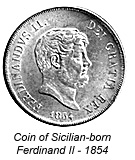 By 1848, enough disillusion had developed to spawn a revolutionary spirit.
The riot begun in Palermo quickly spread across the island and, to a greater
or lesser degree, across Europe. Though King Ferdinand II suppressed this
revolution by force, he considered the situation serious enough to grant
his subjects another constitution.
By 1848, enough disillusion had developed to spawn a revolutionary spirit.
The riot begun in Palermo quickly spread across the island and, to a greater
or lesser degree, across Europe. Though King Ferdinand II suppressed this
revolution by force, he considered the situation serious enough to grant
his subjects another constitution.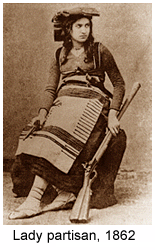 A series of riots followed for several years after the unification, in Sicily and elsewhere
in the South, and only the presence of thousands of Piedmontese troops could
prevent the Sicilians from re-installing Francis II on the Throne. The new
regime didn't only confiscate the national bank (and five million gold ducats
from the Palermo mint), whose assets dwarfed those of Piedmont, it killed
tens of thousands of southerners between 1860 and 1870, civilians as well as
armed partisans; some were summarily executed while others died following years of forced labour in prison camps in northern
Italy. Most were killed for little more than their openly-declared loyalty to the Royal
Family of Naples, and in very few cases were there trials; those who were incarcerated
in Alpine prisons were allegedly guilty of "treason." (This policy contrasted sharply
with that of the
A series of riots followed for several years after the unification, in Sicily and elsewhere
in the South, and only the presence of thousands of Piedmontese troops could
prevent the Sicilians from re-installing Francis II on the Throne. The new
regime didn't only confiscate the national bank (and five million gold ducats
from the Palermo mint), whose assets dwarfed those of Piedmont, it killed
tens of thousands of southerners between 1860 and 1870, civilians as well as
armed partisans; some were summarily executed while others died following years of forced labour in prison camps in northern
Italy. Most were killed for little more than their openly-declared loyalty to the Royal
Family of Naples, and in very few cases were there trials; those who were incarcerated
in Alpine prisons were allegedly guilty of "treason." (This policy contrasted sharply
with that of the 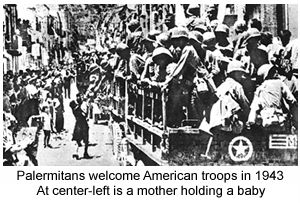 Italian troops had already surrendered at
Lampedusa without a fight. Field Marshall Montgomery's British forces met
the brunt of German resistance on the Plain of Catania. (Patton later dedicated
a plaque in Palermo's Anglican Church to commemorate American lives lost
during the fighting, though the presence of ex-Fascists in Italy's government
seems an affront to their efforts.)
Italian troops had already surrendered at
Lampedusa without a fight. Field Marshall Montgomery's British forces met
the brunt of German resistance on the Plain of Catania. (Patton later dedicated
a plaque in Palermo's Anglican Church to commemorate American lives lost
during the fighting, though the presence of ex-Fascists in Italy's government
seems an affront to their efforts.)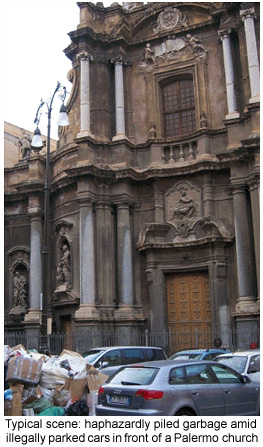 By the 1980s there were at least some signs of