



|
|
|
|
|
|
| ||||||||||||||||||||||||||||||||||||||||||||||||||||||
Home Page Site Search Sights & Activities Localities • Places Good Travel Faqs Sicily's Top 12 Hotels • Planning Maps of Sicily Weather • Climate Nature • History • People Food • Wine • Dining Arts • Literature • Culture Monthly Magazine Sicilian Identity Sicily Links Contact • Follow
|
Sicilian
Genealogy & Family History
In Sicily the existence of genealogical records and the use of a surname in a specific family over many centuries often permits a lineage to be traced, generation by generation, to circa 1500. Sicily's oldest baptismal and marriage records date to around that time, with tax census records (rivelli and catasti) every few decades from the same period. No other place on earth offers such extensive genealogical information over so many centuries for so much of its population. Based on the preservation of these records, at least 50% of Sicilians can trace lineages well into the sixteenth century; in a parish archive one morning we traced the lineage of an ordinary (non-aristocratic) family in the Nebrodi Mountains from 1850 directly to 1550, and later supplemented this with land census records. (In most of Europe, by comparison, a proven, generation-by-generation pedigree to 1600 is exceptional.) Sicily also enjoys Europe's best-preserved feudal (land) records, permitting ready identification of the successive owners of feudal estates from the late Middle Ages until the nineteenth century. (Few regions of Europe enjoy anything comparable.) Relatively little of this information - particularly for the centuries before 1800 - is available online (Wikipedia presently has no entry for Sicilian genealogy) or in other secondary sources; scans and microfilms for pre-1800 may not be very legible. The challenge is finding what interests you. A general strategy follows. Firstly, you should speak Italian reasonably proficiently in order to communicate with people who can help you, and you'll have to be able to read the information they provide. The most useful records you can consult at provincial state archives (usually open weekday mornings) are vital statistics acts of birth, marriage and death between 1820 and 1860. Concentrate on acts of birth and marriage rather than acts of death, which do not provide as much accurate information which will advance a lineage. This presumes that you can read nineteenth-century Italian script and are familiar enough with Italian social history to understand the historical context of the information you are reading. (Sicilian weddings, for example, entailed certain traditional practices, and country life was different from city life.) You'll have to fill out a few forms to consult these records, and photocopying is not permitted, but you may order scans.
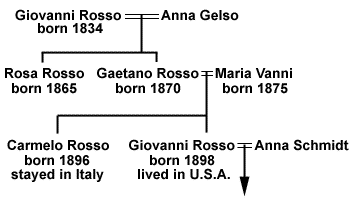
Until around 1880, some seventy percent of Italians (Sicilians as well as Lombards, Tuscans and Piedmontese) were illiterate tenant farmers, farm workers, and day workers. Most owned a house and perhaps a small parcel of land. About twenty percent were skilled craftsmen, scholars, jurists and other professionals. Except in the rare case of an aristocratic or professional family, your Sicilian ancestry will reflect these demographic realities. If you can't research yourself, you may be better off employing a professional genealogist to research your family history, and costs are not usually prohibitive. But don't expect free services. If your heritage is worth anything to you, plan to spend at least €500.00 to discover it; no professional genealogist in Sicily will accept a project for much less. A professional will also be more objective, better able to distinguish genealogical fact from family folklore, and is more likely to be able to produce accurate results, even if months or years are required. Beware of firms that sell coats of arms or attach one to a genealogy they've researched for you. Several "distinguished" research firms based in Florence are infamous for this practice. In Italy, only noble families (barons, counts, et al.) are entitled to coats of arms; nobody can ethically claim the coat of arms of a family with which he is unrelated just because he coincidentally shares a surname with that family. Some people would like to visit Sicily to meet distant cousins, but telephoning people who happen to share your ancestor's surname in an attempt to foster ties with distant relatives is never advised. They may not be related to you closely enough to determine precise kinship, and they probably will not welcome your intrusion into their privacy. It's best to approach these folks indirectly by sending letters a few months before you go to Sicily, enclosing a clear, simple family tree (like the pedigree shown here) indicating lineage at least from the mid-1800s. For a fee, a competent genealogist can assist you in constructing such a chart. This should be a lineal tree showing descent from a single ancestor or couple in the direct male line, not a multilineal pedigree like the ones favored by the Mormons and most American genealogists. Telephone or email only those people who express a willingness to meet you. You will find that Italian genealogical research is an eclectic subject. Don't believe everything you read in web sites, books and magazine articles dedicated to Italian genealogy, especially those published in English (even when these are published by genealogical organizations). Being written by foreigners or amateurs who have little genuine knowledge of Italian history, most of these works are full of historical misinformation and inaccuracies serious enough to impede your success in identifying your ancestors. Understandably, most of the folks who research their own family histories rely a great deal on the stories they've heard from their grandparents, but the discovery of genuine family history requires much more than this. (Some good books on Sicilian history are listed on our books page.) Best of Sicily is not a genealogical service. We do not undertake searches either for dead ancestors or living relatives. At best, we may be able to recommend a genealogist, but we cannot respond to personal queries of a genealogical nature or requests for free advice, such as "Can you help me find my uncle in Agrigento?" or "Please send me the genealogy of Giovanni De Carlo born in Castrogiovanni on May 4th 1878." The right person for these tasks is a competent genealogical researcher
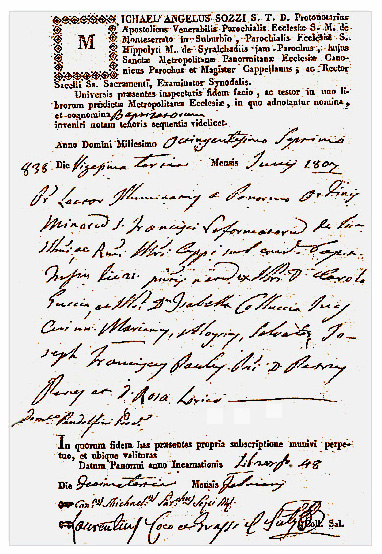
Research Strategy: Here's the basic one for Sicily which gets results at least 90% of the time. 1) Unless you already have a precise knowledge of ancestral information before 1860, consult the stato civile records of birth, marriage and death at the municipio (town hall) in the locality where the ancestor lived. This is the only place to consult records from 1860 to the present. Some town halls retain the records from 1820 until 1860 (duplicates of those at the provincial state archives) as well, but many do not. You may not be permitted to search the records personally, on your own, but they do exist. Make an appointment for this at least a month in advance of your arrival. 2) To extend the line backward in time, consult the stato civile records at the provincial state archive for periods from 1820 until 1860. The processetti matrimoniali (marriage document attachments) may also be available, depending on province. 3) Assuming you have established the lineage to circa 1790 with civil records, the next step is the parochial archive. Be warned that access may require prior approval from the bishop. Catholic parishes are not obligated to assist you, and with the dearth of pastors and personnel it is quite possible you will be denied access. Whereas the LDS Church has microfilmed many civil records, that is not usually the case for church records. As we mentioned, you should make a substantial offering, in advance, if you hope to consult these records, and episcopal permission may be necessary nevertheless. Remember that some localities have more than one historical parish, and therefore more than one archive to consult. This is obviously true in larger cities but even occurs in some towns. In that event, you may end up alternating research between parishes. 4) As supplementary records, you may wish to consult the rivelli, the Sicilian version of the catasti. These are available at the Palermo state archive. Microfilms of these documents are not always legible, especially for those prior to the 18th century. Some are conserved from circa 1500. The most useful riveli are those up to and including the one for 1748; those for the 19th century (beginning in 1811) list property and sometimes the paternity of each taxpayer but not the names of his wife and children. Land plots listed in the riveli may be identified by their locations in manors (or fiefs); this is where feudal and nobiliary records come into play even for families which aren't descended from the aristocracy. Some knowledge of feudalism may be helpful here. 5) The significance of these records is explained in the following chart (links open to examples) and in our introductory article. Local histories have been published for many towns, and these are sometimes useful as they may provide maps and might even mention the family you are researching. Professional Genealogal Research Assistance: We're often asked to recommend a genealogist and we can sometimes do so if you email us indicating the nature and locality of the research. See our tour guide page or the ads on this one for qualified consultants who can accompany you to an ancestral town to conduct basic research in 19th-century records. The Records: now that you have at least a suggested research strategy, the following chart describes important genealogical records sources in Sicily. The numbers in the column headed by an asterisk (*) indicate the relative level of expertise required to effectively use these records, level 5 reflecting the highest degree of training. Several descriptions link to images of the documents mentioned, which will open in a pop-up window (please activate this feature in your browser's preferences) or - if you're using a tablet - a new tab.
|
|||||||||||||||||||||||||||||||||||||||||||||||||||||||||
Top of Page |



 The vital statistics office of the town hall may be able to assist with
more recent records, but due to privacy laws usually will not allow you
to consult these directly, and in larger localities the personnel might
be too busy to help you very much. Parochial records, which are handwritten
in Latin, are useful for periods before 1820, but pastors are often reluctant
to grant direct access to these old registers, and in any event are not
obligated to assist you; many are downright uncooperative. While it is never
a guarantee of success, an offering (in advance) to the parish is presumed if you hope
to have access to the archive. It should be at least two hundred euros in banknotes,
sent via courier or registered post with a polite letter requesting access. Tax census records
(described in the chart below) can also be useful in some cases.
The vital statistics office of the town hall may be able to assist with
more recent records, but due to privacy laws usually will not allow you
to consult these directly, and in larger localities the personnel might
be too busy to help you very much. Parochial records, which are handwritten
in Latin, are useful for periods before 1820, but pastors are often reluctant
to grant direct access to these old registers, and in any event are not
obligated to assist you; many are downright uncooperative. While it is never
a guarantee of success, an offering (in advance) to the parish is presumed if you hope
to have access to the archive. It should be at least two hundred euros in banknotes,
sent via courier or registered post with a polite letter requesting access. Tax census records
(described in the chart below) can also be useful in some cases.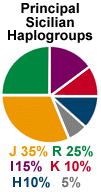 Genetic Research: Beyond actual
documentary records, currently available genetic (DNA) analysis
is useful in establishing kinship with cousins through the patrilineal line of ascent (i.e. your father's father's father et al.). As this
corresponds with surname inheritance, its value to genealogical research is obvious. Genetic analysis in female
matrilineal research (your mother's mother etc.) is less practical in genealogy. See our
Genetic Research: Beyond actual
documentary records, currently available genetic (DNA) analysis
is useful in establishing kinship with cousins through the patrilineal line of ascent (i.e. your father's father's father et al.). As this
corresponds with surname inheritance, its value to genealogical research is obvious. Genetic analysis in female
matrilineal research (your mother's mother etc.) is less practical in genealogy. See our