

|
|
|
|
 |
|
|
|
| ||||||||||||||||||||||||||||||||||||||||||||||||||||||||||||||||||||||||||||||
Home Page Site Search Sights & Activities Localities • Places Good Travel Faqs Sicily's Top 12 Hotels • Planning Maps of Sicily Weather • Climate Nature • History • People Food • Wine • Dining Arts • Literature • Culture Monthly Magazine Sicilian Identity Sicily Links Contact • Follow
|
(Candid) Travel FAQs While our favorite island is a great place to visit, it's no closer to perfection than any other place we know – be it Ukraine, Japan, Ethiopia or the United States. This page is read by over a thousand people each day, and these questions and responses reflect conditions and circumstances that you may (or may not) encounter in Sicily. Observations regarding inter-cultural differences, in particular, are generalities; your own experiences may differ. We cannot guarantee that all schedules or contact information are presently accurate or current, and we cannot accept responsibility for events, circumstances or damages resulting from use of this page. (This page was last updated in February 2018.) Can you provide some concise information about Sicily? Find it on our Sicily Facts page succinctly presenting information on Sicily's population, geography, government and economy. Where can I find general travel information for Sicily? If it's not on this page check out our travel planning page for hotels and our "Fast Planning Links" to things like currency conversion, weather, museum information, airport details, airlines servicing Palermo and Catania, tours of Sicily and much more. We also publish a website dedicated to travel in Palermo, Sicily's largest and (in many respects) most interesting city. What's the best approach to sightseeing? Our sightseeing page offers tips about various approaches to seeing Sicily, such as independent travel (by car or otherwise), guided tours - and also what kind of choices are best avoided under most circumstances. Will Italy's ailing economy have an impact on my trip? No - though this is a good (and fair) question. Don't expect any particular difficulties. Serious as it is, Italy's economic situation won't make any difference in your visit to our sunny island. Public services won't be influenced in any significant way, and neither will air travel or lodging. What's the difference between a tour operator, travel agent, travel consultant and travel concierge? These distinctions are important, especially if you're planning a trip for more than just a few people. Read our tour operator article for reliable information and accurate definitions of these oft-confusing terms. Are there visa requirements for visitors to Italy? There aren't any particular requirements for citizens of European Union nations. Citizens of Japan and most English-speaking nations (Australia, Canada, New Zealand, United States) in possession of valid passports can stay in Italy for up to 90 days without a visa. Contact your nearest Italian consulate if you have questions or would like to stay longer, or to find out if your country is currently in the visa-waiver programme. What about driving license requirements? Though foreign licenses are usually honored at car rental agencies and by the government, you should obtain an international permit (a supplementary document obtainable from automobile clubs) if your license is not issued by an EU nation. Nobody under 18 years of age may drive a car in Italy, even if he or she holds a valid license in a foreign nation. What are driving conditions like in Sicily? In certain cities, such as Palermo and Catania, they can be challenging for those unaccustomed to chaos. Many motorists are careless, and often downright disrespectful of the rights of those with whom they share the streets. Some roads, especially those in and around Palermo, are not suitable to the large volume of traffic they must accommodate during the busiest hours. In Palermo, the worst times are from 8 to 9 weekday mornings, and from 1 to 2 in the afternoons. Saturday evenings between 7 and 9 also have heavy traffic. Catania, Messina and other cities may also be choked by traffic during these hours, though the situation at Palermo is far worse. Is it easy to use the Palermo and Catania airports? While you probably won't get lost at either one, it's good to keep a few things in mind. Your baggage will have to be checked at customs if it hasn't yet been inspected and you're arriving from a non-EC country. A simple matter, but first you have to find your luggage, which may arrive in the international baggage claim area, not the baggage carousel assigned to your domestic connecting flight from Rome or Milan. So if your baggage was "checked through" directly from New York, Toronto or Sydney, and you haven't seen it since then, you will have to claim it in the international area, which is clearly indicated. Catania's Filippo Eredia (Fontanarossa) airport is a new facility, expanded in 2007. In the event that your bags aren't found in either claims area, it is possible that they'll arrive with the next flight if you flew with Alitalia from Rome or Milan. If the next scheduled flight arrives only an hour after yours, it's probably worth waiting to see if your bags arrive with it before going on to Palermo or Catania. Owing largely to their small size, Sicily's airports are quite efficient. In addition to those at Palermo and Catania, there is a smaller airport at Trapani with flights to Palermo, Lampedusa and Pantelleria. The airport of Reggio di Calabria (on the other side of the Strait of Messina) has flights for Rome and Milan. For more info check out our arrivals and airline pages. How do I get to the city from the airport? Unless somebody is meeting you at the airport, you'll have three choices: bus, train (in Palermo), taxi or rental car. The Palermo airport is about a thirty minute drive from the city; the Catania airport is about twenty minutes from Catania. Buses depart about every thirty minutes until around 10:00 PM, and are less frequent after that hour. Departures from Catania airport are less frequent generally, but there's usually a departure every forty-five or sixty minutes during the day. Fares are about €6.00. Trains depart for Palermo from that city's airport once every hour between around 6 AM and midnight, stopping at the Notarbartolo and central train stations in Palermo. The Palermo buses stop in the city at Via Lazio and then Piazza Ruggero Settimo (Politeama Theatre) before proceeding to the central train station; the Catania buses go near the city center, but not necessarily through it, before proceeding to the large piazza near the train station, which itself is not very far from the center of town. From Catania's airport there are also buses for Taormina. From either airport, fixed fares for taxi travel to the center of town are less than €50.00, though Catania's airport is much nearer the city. Rates vary, with evening fares being slightly higher than the daytime ones. To avoid misunderstandings and possible price gouging, ask to know the fare price before entering the taxi. Car rental agencies are located at both airports. Reservations are suggested, especially during the busy summer months. Most of the airport car rental services have branches in the cities as well. Please note that most available automobiles have manual, rather than automatic, transmissions. For more info check out our arrivals page. How do I get there by train, ship or bus? Some trains from Rome and Naples go directly to Sicily, which means you won't have to change trains along the way. If, however, your train's ultimate destination is Reggio Calabria, you'll have to get off at a small locality called Villa San Giovanni (about 15 minutes before the city of Reggio) and take a ferry across the Strait to Messina to the railway station there. The ferry service is on the lower level of the train station; the crossing takes about 30 minutes. (In the event of a ferry strike, you may be able to travel via hydrofoil with one of the operators near the station.) If you're coming by train, you're probably arriving from Rome, Naples or Bari. It takes an hour or more to transport the train onto a ferry at the Strait of Messina, cross the Strait, and unload it in Sicily. A faster (InterCity) train will arrive in Palermo from Messina in about three hours. The stretch from Messina to Catania takes half as long. Within Sicily, we generally recommend trains for travel along the coasts, or for certain inland trips of less than ninety minutes' duration, and then only to major cities or towns located near their respective stations. This means the lines: Palermo to Termini Imerese to Cefalù, Messina to Taormina to Catania to Siracusa, Palermo to Agrigento, and vice versa. Within Sicily, it's faster and easier to reach most points by bus, though there is railway service to some destinations. These buses are usually blue and depart from points very near the train stations. If you have plenty of time, you might consider train service between certain points, such as Messina-Palermo, Palermo-Agrigento or Messina-Taormina (Giardini). Other than these, it's not recommended. By ship, your port of arrival will depend on where you're coming from. Most ships from Naples arrive at Palermo (it's about 11 hours by overnight ferry and 4 hours by hydrofoil), while most ships from Malta arrive at Catania. Though they are hardly tourist sights, Sicily's main ports (where the cruise ships also dock) are conveniently located near urban centers. Our links page indicates ship and hydrofoil services. Once you arrive in larger cities, we suggest that you purchase a detailed city map, available from most newsstands. Various local bus routes depart from the train stations (local buses are orange), but as these are indicated by street, you'll have to know precisely where you want to go if you wish to arrive (at your hotel or anywhere else) without a lot of unnecessary hassle. For more info check out our transport page. Villa San Giovanni, the mainland Calabrian town where you board the ferry for Messsina, is only about six hours from Rome if you take the Autostrada (Route A1 from Rome to Naples, then Route A3 to Villa San Giovanni). The A20 from Messina to Palermo, or the A18 from Messina to Catania, will take you to these cities. What's the best way to travel within Sicily? That depends on where you're going, what you plan on doing, and how much time you have. You may wish to make use of trains or buses for some trips and a rental car for others. We discuss this in the question (above) about travel by ship, train and bus. For local (city) buses, you'll have to purchase a fare ticket which must be stamped in a machine when you board. Newsagents, tobacco vendors, and even some bars, sell these tickets for around €1.20 each, and they're valid for 60-90 minutes from the time they're stamped. Boarding a local bus without a ticket could earn you an immediate €50.00 fine, and some ticket inspectors, especially in Palermo, are not distinguished for their tact or diplomacy. (They get a bonus commission for each fine collected.) Another important note on local practices: You must be at a bus stop to get the bus, of course, but then you must waive to indicate to the bus driver to stop to allow you to board. Otherwise, the bus will pass you by. For more info check out our transport page. How's the taxi service in town? It's not bad, though it's never cheap and costs even more after 8 in the evening. The problem for foreigners is that many Sicilian taxi drivers, though congenial, might not be characterized as scrupulously sincere. They may overcharge you if they realize that you don't understand Italian well. As we said earlier, it's always best to establish the price before getting in the taxi. Incidentally, the same principle applies to Palermo's horse carriage drivers. Unlike their counterparts in London or New York, the taxi drivers here will not stop for you along the street unless you are at a 'taxi stand' (at the airports, train stations or in principal squares or larger hotels). For more info check out our taxi article. If time is limited, what are the "must see" places to visit in Sicily? While this naturally depends on your tastes and interests, our Top 12 Places to Visit offers good suggestions. Where's the most interesting scenery? Sicily's scenery and geography is described by region on a page dedicated to that topic, with links to other pages about things like country life. Most of the better public beaches are listed on our beach page, where you'll also find a map indicating where some of the better ones are located. Read about golf in Sicily and find an 18-hole course. Our article includes a simple map indicating Sicily's three golf clubs. Our Sicily tour guide page is a good place to begin. In addition to a selective list, it also has a few suggestions for rates and services. If I can't understand most of the menu, how will I know what I'm ordering? In most restaurants the staff is helpful. Take a look at the culinary terms section of our Food Page, where a number of words and phrases are translated and defined. There you'll find links to dozens of culinary topics. Although our hotel and trip planning page reviews only four star and three star hotels, which cost at least €80.00 per night for a single room, less expensive lodging exists. (TripAdvisor.Com is a good source for finding it.) Meals don't usually cost much in Sicily compared to other regions of Italy; it's possible to order a good seafood meal for €25.00 and a delicious pizza for €9.00. There are some ironies, however. For example, there are pizzerias where beer (either bottled or on tap) costs almost as much as the pizza. Resort areas like Taormina are understandably more expensive than other places. The advantage of larger cities like Palermo and Catania is that they offer a wider range of prices. Gas (petrol) is expensive but public transportation is inexpensive compared to Germany, the US and the UK, although it must be said that Italian train service is not as efficient as what you'll find in those countries. Is it easy to get ripped off in restaurants and other establishments? Fortunately, this doesn't happen as often as some visitors seem to expect. In restaurants, however, it's sometimes best to order from a written menu, where prices are indicated, instead of ordering from a "verbal" menu that a waiter has described. This isn't always practical because some restaurants (especially better ones) change menus daily and don't bother writing them out --though by law they're required to. Remember that a nominal "cover" charge (coperto) is usually added to the price. None of the restaurants mentioned in this site are likely to charge inflated prices, and we've been especially careful to review restaurants in Palermo to ensure that none of those listed engage in misleading pricing practices of any kind. In stores that don't clearly indicate prices of merchandise on display, don't be shy about asking how much an item costs. Simply point to it and ask "Quanto costa?" Despite what you may have heard, it does occasionally rain and snow in Sicily, and it's cool on Mount Etna even during the Summer months. Apart from this, keep in mind that it's a good idea to wear comfortable shoes because it's inevitable that you'll be doing a lot of walking. There are a few other points to keep in mind. Italian adults don't usually wear white running or exercise shoes (sneakers) outside the gym; American visitors to Italy are often identifiable by the large white sneakers they wear. Women should not wear shorts, or even sleeveless blouses, when they enter Italian churches. (In Italy, men rarely wear short pants.) You may notice that, in general, Italians dress slightly more formally than Americans and North Europeans, though they have some peculiarities of their own which are common enough to represent conformity. (Examples are the unchanging style of young men wearing blue blazers with jeans, young women wearing black miniskirts with black stockings, and older widows wearing black.) Topless bathing is permitted on Italian beaches, but very few Italian girls go topless on beaches near their homes, reserving this habit for their trips abroad; most of the topless sunbathers in Sicily are foreigners from northern Europe. Will communication be difficult? If you don't speak Italian, but plan on traveling by yourself or with a small group that won't include an Italian speaker, we suggest learning at least a few Italian words and phrases before you arrive. This will come in handy in more remote parts of Sicily. Even in Palermo and Catania, there aren't many people who speak English, but enough of the folks in airports, hotels and restaurants understand it well enough to make basic transactions go smoothly. Even if you do speak Italian, you might not understand everything the Sicilians are saying to each other, since they may be speaking the local dialect (actually a distinct language), but they all speak Italian. Translations of some common culinary terms will be found on the Food Page. If my travel agent can't find me an interpreter or guide, can you recommend one? Best of Sicily doesn't offer general business or travel services, but our email has convinced us that there's a real dearth of competent interpreters and guides. We may be able to recommend an interpreter or guide if you describe your requirements, but availability of these specialists varies greatly. These services are described on a separate page. How is mobile and internet service? Let's consider several options: In Italy your mobile carrier will use the services of TIM, Vodafone or Wind, all of which have service centers in major cities (in Palermo they're all in the same part of Via Libertà). Italy's mobile networks and service are among the world's most efficient and, all things considered, most economical. You may even find it practical to purchase a cell phone account (using pre-paid cards) in Italy for your use while you're here. As the dimensions and format of European SIM cards are different from those used in some regions, you may have to purchase a phone here in Italy to follow our advice. Prepaid or billed telephone cards like AT&T, MCI or BT are increasingly being replaced by cell phones. Using such a card, you'll still have to make a toll free or local call to make a connection to your service's access number for Italy. From an Italian phone booth (these are becoming a rarity), you can do this with a prepaid domestic telephone card (carta telefonica), purchased for less than €10.00 from a tobacco shop, newsagent or (in some cases) bar. Italian residential and hotel telephone rates, based on those of Telecom Italia (the national telecommunications company) are among Europe's highest. We recommend that you avoid using Telecom to make international calls. Internet points often offer long-distance phone service. Where can I find an internet access point to check my email? Unfortunately, though these exist in Palermo, Catania and Taormina, they're not always easy to find. Some are really nothing more than small photocopy shops or computer service stores located on side streets away from areas frequented by travelers. Better hotels may offer internet access to their guests. Visit our Internet Access page for a (short) list of services. How do I find a good bed and breakfast in Sicily? Here the operative word is good because quality varies widely. Our Sicily bed and breakfast page is a good place to begin, and while it offers fewer choices than you'll find on a site dedicated to the subject, everything listed is of high quality. The advice presented there is useful too, especially if you're a novice to the world of B&B. Return to the top of this page. How do I transport purchases back home? Presuming that these are small enough to fit inside your luggage, we suggest, for fragile items like ceramics, that you transport these as carry-on baggage. The red tape involved in a customs exemption claim (for "duty free" items) probably isn't worth the effort in most instances. We do recommend, however, that you bring a meter or two of plastic "bubble wrap" (available at packaging shops like Mailboxes Etc., which also has outlets in Sicily) with you for wrapping fragile items you want to take home. This useful material is lightweight and won't take up much space in your bags, but it's not available from many vendors in Sicily. Current regulations dictate that liquids such as wine cannot be transported as carried-ons. What are restaurant, store and museum hours like? Hours vary greatly from place to place. The most annoying aspect about Sicilian hours, compared to those in Milan and a few other northern cities, is the three-hour afternoon break from 1 till 4, when almost everything is closed except for a few restaurants. Early evening closings are another fact of life here; don't expect to find a supermarket open after 8 PM. Most pharmacies are also closed at night, though a few in each quarter have night schedules to accommodate emergencies. In August, many stores are closed in the afternoons, and some are closed altogether for at least two weeks in the middle August (Ferragosto). In general, principal archaeological sites are open from 9-12 AM and 4-7 PM Monday through Friday, and 9-12 AM Saturday; summer hours may be longer. Museums are open from 9-1 Tuesday through Saturday, and some weekday afternoons. Some are closed Mondays. Many (but not all) churches are open in the morning from 8 till 12, and some are open after 4 PM. Most shops are closed Monday morning and all day Sunday but open 9-1 and again 4-7:30 on other days, including Saturdays. Museums and archeological sites may charge as much as €12.00 for admission. Certain parts of sites belonging to the Catholic Church may also charge an admission, not to enter the church itself but for entry to a museum or cloister. Restaurants such as pizzerias are open evenings from around 8 Tuesday through Saturday; many are closed Sunday and Monday. Some restaurants are open for lunch, too, usually from around 12:30 or 1:00. Don't expect to find pizza served at lunchtime, and don't expect to find too many all-night restaurants in Sicily. Speaking of restaurants, some of Palermo's better ones are described at Palermo's Best Restaurants. During which holidays are these places closed? Many businesses close for two or three weeks in August, when most Italians go on holiday. It may seem bizarre, but about 70% of the population takes their vacation at the same time, and hardly any work gets done in Italy during that period. It's worth mentioning holidays, when you'll find most monuments, restaurants
and shops closed:
They're not as frequent as many visitors imagine. They usually occur during the Summer or around Christmas and rarely affect all flights or train departures in all regions. Strikes are usually announced during the TV news shows at least 24 hours in advance. Where can I get more visitor information? There are information centers in certain locations; in Palermo and Catania,
for example, there are information booths at the airports, and in Palermo
there are several in the In small towns, you may find a local information office called a pro loco which can provide you with news of upcoming local events, nearby sights, and so forth, though it is not likely that the pro loco's staff will speak English. We suggest our links page for more ideas. There used to be provincial tourist information offices, but now most are local, based in places of popular tourist interest like Siracusa, Taormina and Cefalù. The official Sicilian regional tourism website is poorly-edited (by a firm in Milan) in English so terrible that we would be ashamed to recommend it. What's the best travel guide book for somebody planning a visit to Sicily? Each has a different emphasis and angle. See our books page for some solid recommendations. For general road maps, we recommend those published by the Touring Club Italiano. These are available at book stores in larger Sicilian cities like Palermo and Catania. A legend explains symbols in Italian, English, German, Spanish and French. In general, we recommend that you purchase souvenirs and craft items, such as ceramics, at shops that specialise in the manufacture of these objects. A souvenir shop or stand that sells everything from porcelain to ceramics to medieval-style marionettes is not likely to have the selection and quality of items available from specialty shops that make the wares they sell. That said, there are some shops at Taormina and Monreale which retail the products of various manufacturers and offer a good choice of items. The specialty guideline also applies to fashion items. A leather shop, even if it is not large, will offer a better choice and quality of merchandise than a department store that sells various items, though department stores in Italy are not very large. So it's best to buy things like silks (neckties, scarves) and leathers (belts, purses) at specialty shops. In fact, specialty shops are the norm in Italy, whatever you're looking for, and the prices are usually fair. What are country retreats ('guest farms' or aziende turistiche) and what are they like? And what about renting a villa? Visit the guest farm page to read about 'agriturismo,' with several recommendations. We also have a villa page. What do the mineral spring resorts offer? In contrast to the rustic setting of the typical country retreat, hot mineral springs and mud baths (or, if you prefer, "holistic mud treatment centers") are health resorts that offer a range of therapeutic treatments. These naturally vary according to the resort you choose. Some offer massage therapy and exercise programs (even something called "passive exercise classes"), as well as diet counseling, while others specialize almost exclusively in hot mud therapy. The locations of the resorts themselves vary greatly. The older establishments at Termini Imerese and Sciacca are actually in small but crowded cities, while the one at Castellamare del Golfo is in a charming coastal town, and the one at Sclafani Bagni is in the country. The facilities are usually very good. A stay in one of these resorts may be relaxing, and will certainly cost more than a sojourn in the best hotels in Sicily. It may even yield a few passing health benefits, and will make you feel better, but don't expect miracles. I would like to learn to cook Sicilian food. Are there any cooking schools in Sicily with English-speaking instructors? See the sponsored link on this page or check out the links page. Are the cities safe for visitors? What about purse snatchings? As far as violent street crime is concerned, Italy's largest cities are quite safe compared to London, Paris, Moscow, and certainly New York and Los Angeles. Since purse snatchings are commonplace (the creative Italians even use motor scooters to ride by as they snatch handbags), women are advised against carrying large purses, especially in the cities (see below). Though assaults are rare, they do occur, especially in certain parts of Palermo and Catania. An attractive young woman walking around some parts of these cities alone after 10:00 PM could be a tempting lure for an unsavory male. (As we describe below, a few Sicilian men entertain a rather unenlightened view of women.) The prevalence of violent street crime shouldn't be exaggerated, though its potential presence is worth a bit of prudence. You may wish to visit our travel safety page for other observations. Most of the self-serving "travel advice" for "tourists" offered by the Italian and Sicilian travel bureau sites should be ignored, especially as regards matters like traveler safety in public areas. Organized crime doesn't pose a threat to visitors. Mafia shootings are quite rare; you're far more likely to see one described in the newspaper or on the evening news than to witness one firsthand.
How do I contact my country's consulate in Sicily? Most countries' consulates general for southern Italy are based in Naples or Rome. However, there are a few vice consulates in Palermo and Catania, and also a number of consular representatives --agents or honorary consuls who can help you out in an emergency but not in bureaucratic matters. In most cases, unfortunately, consular agents and honorary consuls are Italians, rather than citizens of the nations they represent. Don't expect full consular services from the representatives indicated here. Here's a list of addresses:
What kind of things are there for children to do? Our article on Sicily for children suggests a few possibilities. To get your teens interested in Sicily we suggest Sicily for Students, a convenient links page What's the electrical voltage in Italy? Will I be able to use my cell phone charger or plug in my computer? The electrical current in Italy is 220 volts at 50 cycles. This won't be a problem if you're coming from another European Union country, but in the United States the standard current is 110 volts at 50 cycles, so a transformer may be needed to convert Italian power to the American standard. In any event, an adapter may be necessary because British, Australian and American plugs (to cite just three examples) are different in design from Italian ones; their prongs won't fit into Italian wall sockets. Some computers and cell phones are designed to adapt to the current variation internally, without need for an external adapter - but do not presume this. It's best to check the owner's manual. Airport shops (and occasionally in-flight 'duty-free' services) at larger airports outside Italy are a good source of adapters; those in Rome, Milan and Palermo are more interested in selling you food and wine than practical items of this kind. Any special advice for a woman traveling alone (or with a few other women) in Sicily? There's no cause for paranoia. Just remember one thing: Even at the beach, in a hotel or in other public places, keep in mind that gestures or actions which might not be considered provocative in Canada, the United States, Australia or Northern Europe could be construed this way in Italy. That's why a Sicilian woman might seem somewhat reserved when she's alone with a man she doesn't know, even in a business situation. We discuss this below. (But it's not only a Sicilian thing; a lot of men in Milan, Turin and Rome behave the same way.) What other cultural differences will I encounter? Many cultural differences are so subtle that you'll hardly notice them during your stay in Sicily. It's probable that the most pronounced difference will be the Sicilians' unorthodox sense of time and priorities, and the long afternoon "closure" from 1 till 4. The pace of life is slow, and schedules seem to have little importance. Though this condition exists throughout Italy, it is more evident in Sicily than anywhere else. Realistically, such inefficiency doesn't usually bother vacationers who, after all, are in Sicily to take a break from daily pressures and have a good time. But you'll probably notice other things, too. Drawing the Line: Throughout Sicily, and especially in Palermo, most people seem reluctant to stand on line in an orderly fashion. They often crowd around bank teller windows, ticket booths, food stands and cashiers with little respect for the fact that somebody else arrived there first. Common Courtesy: Italians are generally nice people, but Italian society is essentially socialist in its outlook. Certain employees of public services are sometimes careless about the way they treat customers. This is something you may notice in the post office or elsewhere; the bus ticket inspectors are infamous for this. They seem to presume that everybody is dishonest. Restaurants: In most restaurants you'll be charged a "coperto" (cover charge) of one or two euros for each person seated. This nominal charge appears to have originated as the fee for the staff to"cover" the table with a table cloth and serve bread. Tipping is separate, of course, but the coperto persists because Italians are notoriously cheap tippers. One of the reasons that many waiters prefer foreign customers, particularly Canadians and Americans, is that these diners are usually more generous. Incidentally, standard tipping in restaurants is 10% or more. While we're on the subject of restaurants, don't be surprised by the lack of a bread plate at your place, and don't bother asking for one because the staff may not know what you're talking about. The bread will arrive in a basket or plate from which you should serve yourself; don't worry about getting crumbs on the tablecloth. It's expected. Air Mail: Certain public services are rather inefficient. The postal service, for example, is terrible, with frequent delays and theft. If you have to send anything much more valuable than a post card or letter to another country, use a courier service. There are MBE (Mail Boxes Etc.) outlets in larger cities that can send a package abroad via UPS or FedEx, and they also handle Western Union money transfers; these are quicker than bank wire transfers, which in Sicily can take several days. Consult the local phone book for an MBE store near you. If you do send a post card, you may have to purchase your stamps at a tobacco shop because post office windows, which usually have long lines but no automated stamp meters, sometimes run out of stamps in certain denominations (usually the ones you need). The Law: Italy has peculiar laws that could affect you as a traveler. These laws are not especially cumbersome but (to Americans in particular) some may seem like invasions of personal privacy. In practice, too many Italian laws presume that everybody is dishonest (and therefore guilty of something). For example, if the Financial Police (Guardia di Finanza), a military agency with wide-ranging powers, ask to see your receipt (scontrino) as you exit a restaurant or shop, it is because they want to ensure that the appropriate taxes were charged. Sales tax (value added tax) in Italy is almost 20%, and is included in the purchase price of most goods and services. Not having a receipt doesn't mean you're in any trouble, but it could mean an on-the-spot audit and court summons for the merchant. A bit bizarre, since the uniformed officers issuing the summons are over-armed, equipped with fully automatic sub-machine guns. When you check in to a hotel, the desk clerk will ask to see your passport, which he may hold for a few hours since he is required by law to compile a form that must be presented to the police. (You may provide a photocopy to avoid this inconvenience.) This is actually an ineffective anti-Mafia law, enforced throughout Italy, intended to track criminals' movements. (The senators who proposed this law apparently forgot that most such criminals travel on fake identification documents.) In the event that you visit a library or public archive, you'll be asked to complete a form which requests information such as your profession and place of birth, as though this personal information were somehow relevant to your consultation of books or other items. (Surprising they don't ask your weight too.) Money: One of the funnier aspects of spending your money in Sicily (until it happens to you) is that many supermarkets and other stores often cannot change a large bank note. Supermarket cashiers will frequently lose a sale before they'll try to break a larger euro note. Owners of smaller establishments prefer to pocket as many of the immediate profits as they can, as soon as they possibly can, and in their hasty greed fail to consider the needs of their customers. They may even presume that you'll wait for ten or twenty minutes until a customer comes along who has the smaller notes the store needs to change your larger one! Fortunately, the change problem is less severe at restaurants, hotels and other establishments that serve foreigners. Public Lust: During the passeggiata (afternoon stroll) in larger Southern cities, it's not unusual for undisciplined young men to call out to attractive young women they don't know with remarks like "Bella!" and "Pupa!" Sicilian women are quite accustomed to such behavior, though they usually don't encourage it. In itself, such practices are usually innocuous, but they do reflect the persistent attitudes of some Italian men accustomed to viewing women as potential sexual conquests rather than social equals. Throughout Italy, sexual harrassment is somewhat common in the workplace (or at least moreso than in the US and the UK), and southern men seem to do it more openly than northerners. You might observe that many Italian women, though perhaps better-educated than the men they're married to, conform to "traditional" roles in society. Some of these things are quite subtle, others less so. Legally, of course, Italian women have the same rights as men. Socially, that's not always the case. In such an old society, old habits disappear slowly. How much time should I plan to spend in Sicily? That obviously depends on what you want to see or do while you're here, but here are some general guidelines. Let's say that you're interested in a general "tour" of some major sights and cities (Palermo, Cefalù, Etna, Siracusa, Agrigento, etc.). If you're driving, eight days would be sufficient; if you're traveling by train (and occasionally bus), you might want to add a few more days. Palermo is the only city whose sights usually require more than a day to see (we recommend at least two). On the other hand, if you want to spend some time at the beaches, or just take more time to visit places at a more leisurely pace, two weeks would be good. Of course, there are those who prefer to spend an entire "season" in Sicily by renting a seaside villa for three or four weeks. A great idea, but remember that Sicily is usually quite hot during July and August, and that some beaches are particularly crowded in August, when most Italians go on holiday en masse. Foreign students who choose to study in Italy for a semester or two usually attend universities in Rome, Florence or Bologna. Hardly anybody comes from abroad to study in Sicily (at the Univesrity of Palermo, for example), since the universities here aren't particularly distinguished except for highly specialized historical or archeological studies. Besides Catholic churches, are there other places of worship in Sicily? There are several Orthodox churches (not to be confused with Byzantine Catholic ones), two Anglican churches (in Palermo and Taormina), several public mosques, and a few Pentecostal and Mormon congregations, as well as Waldensian parishes. You'll find these listed in the phone book or the city guide (Tutto Città) as chiese di altri culti and some have websites. There is a small synagogue in Siracusa. When's the best time to visit Sicily? For general sightseeing, we recommend the periods October through November and March through June. For skiing on Mount Etna, late January and early February are best. If you're a dedicated vacationer who can't get enough sunshine and beaches, we recommend June through September. Remember, however, that July, August and the first two weeks of September are extremely hot, and bear in mind that almost everybody in Italy goes on vacation in August, making for crowded beaches during that month. However, if your taste runs to the unconventional, creative or independent, consider Sicily in Winter. Our Sicily weather page will give you current conditions, the forecast and month-by-month temperature and precipitation information. We commend you to our page on the real Sicilians. Where can I get accurate historical and cultural information on Sicily?
Where can I find the best dance clubs and other night life? Most of the dance clubs (discos) in Sicily's larger cities are located in out-of-the-way places, often in buildings that don't look very exciting from the outside, and some are far from the cities, "in the middle of nowhere." Many have seasonal schedules. It's easiest to ask the staff at your hotel where to find the ones closest to you, or the "hotter" ones worth a special trip. Sigonella, often referred to by its American residents as "Sig," is the United States Naval Air Station near Catania. The presence of this military base is a reminder that one thing that hasn't changed in thirty centuries of Sicilian history is this island's strategic importance. Sigonella, the last U.S. military base in Sicily, stands on land leased from the Italian Republic by the United States government for tens of millions of dollars annually, and according to treaty the base must employ a certain number of Italian citizens for its day-to-day operations. After the Italian government (and government-controlled services) and a few large firms (Fiat closed its Sicilian plant in 2012), the US Government is the largest employer in Sicily. Military bases are not usually indicated on commercial maps, so we've chosen not to indicate Sigonella on our map of Sicily. For further information, visit their web site at www.sicily.navy.mil. Not as much so as some parts of western and northern Europe, though it is not nearly as homophobic as parts of eastern Europe and certain predominantly Muslim countries. Here we strongly recommend discretion in matters like showing affection in public - though Italian heterosexual couples are unrestrained in that regard. There aren't many exclusively gay bars. One of the main issues for travellers is whether hotels are gay-friendly. The largest cities (Palermo and Catania) and a few sophisticated resort areas like Taormina are perhaps the most open-minded, smaller towns much less so. In general, bed and breakfasts are recommended over hotels, and a web search with sicily hotel gay friendly will turn up at least a few. In fact, bed and breakfasts are a booming business here, having effectively taken business from many pricey hotels. Sicily appears to be more lesbian-friendly than gay (male) friendly, and in any case more accepting of same-sex couples over 40 than younger ones. Sicilians have elected openly-gay politicians to important leadership positions, so it is clear that - speaking generally - they are indifferent to personal matters of this kind. See the links page for sites listing gay-friendly venues in Sicily. Can you offer any advice for physically challenged (handicapped) visitors or those with special needs? We have a page dedicated to the topic of Sicilian travel for physically challenged visitors. Do you have information on events? Our events page describes events which occur annually around Sicily. You'll have to find more detailed schedules on your own, but we suggest good methods for doing so. Is nudity permitted on public beaches? No. Despite what certain Sicilian naturist (nudist) organisations may tell you, national law prohibits full nudity on public beaches, which in Italy are all governed by national statute (despite the occasional case of an eccentric mayor "permitting" nudity on "his" beach). Toplessness, however, is permitted, though perhaps less commonplace than you may imagine if your point of reference is Ibiza or some other popular Mediterranean resort. Let's (succinctly) consider the realities here: Firstly, few of the young women you see sunbathing topless on Sicily's beaches are Sicilian or even Italian; most are foreigners. This is oddly consistent with what you'll see elsewhere in Italian life. Italian women wear the world's tiniest miniskirts but very rarely go braless. Some may cultivate a different fashion when they're far from home, but that's a whole other topic of discussion... Secondly, most of the nude sunbathers on the public beaches where nudity is sometimes (if unofficially and perhaps illegally) tolerated are single men; you'll only rarely encounter women, couples or families on these beaches. That's a statistical fact, and indeed Sicily's few naturist organisations count far more men than women among their memberships. This implies no judgement on our part, but rather a simple recognition of what you are most likely to encounter at the so-called "nude" beaches, and something to consider before visiting these. In view of reality and law, the designation (by a handful of Sicilian naturists) of particular beaches as "clothing optional" is nothing short of ridiculous. What is meant by high and low season? These terms are used in the lodging and travel industries relative to the seasonal variation in prices of flights, hotel stays and other services available throughout the year. Speaking generally, High Season refers to the warmer months, from April through September, while the Low Season is usually defined as October through March. We sincerely believe that the winter is a perfect season to visit Sicily. Check out our weather and climate page for information on average temperatures and precipitation. Will regional (Mediterranean) conflicts impact a stay in Sicily? No. Not at all. While it is true that Italy has been indirectly involved in some of these conflicts - with Libyan and Tunisian refugees arriving on Lampedusa and the southeastern Sicilian coasts - they have not imposed any other conditions that you can see. Sicily is a big island (about the size of Wales or Massachusetts), and even during the Libyan "civil war" of 2011 the only evidence you might have encountered were a few military jets at the Trapani airport. Is there accommodation for those having special dietary restrictions? For information regarding specific diets (Gluten-Free, Vegetarian, Vegan, Kosher, Halal), please visit our page on health and dietary restrictions. How do I find a genealogist or somebody to take me to an ancestor's place of birth? We can sometimes recommend Sicily-based genealogists for specific research projects. See the genealogy page for general information on available records and sound research strategies. The tour guide page lists a few travel consultants familiar with vital statistics records who can take you to an ancestral locality to visit and research 19th-century records while you're there. We should stress the importance of competence here, and your planning must take into account such details as public office hours and Italian public holidays. What are suggested literary itineraries? Are there literary parks in Sicily? Sicily has had more than its share of great literature: Verga, di Lampedusa, Sciascia, Pirandello. Some tour operators can plan a literary tour based on the places described by these Sicilian writers. A few tour guides also offer presonalized tours of this kind. The literary museums and parks dedicated to Pirandello and Sciascia are good, while others may leave something to be desired. Any advice for expatriates moving to Sicily or searching for employment in the local economy? Here we suggest our (very) candid expatriate and jobs pages. How much cash should I bring – as opposed to credit cards? At least a few hundred euros. Are the various Sicily tour/excursion services advertised on the internet reliable? Everything advertised on this website is legal and reliable, but we cannot speak for the others. (Yes, that may seem self-serving but it's a simple reality.) As regards such services generally (personalized excursions and the like), the most important factor is whether the person or firm you are paying is fully insured. Imagine, for example, a visit to Agrigento or Segesta: Do those offering these excursions cover basic liability if you, the client, fall and suffer an injury between the parking area and the temples? Here in Italy, a licensed tour operator or taxi driver qualifies for such insurance; a "cultural association" or "independent" driver/guide might not, despite what they may tell you. (For this reason, we do not accept their advertising on this website.) Potential injuries aside, your tour or excursion will become most unpleasant if your "guide" is stopped by police and his car is impounded during your tour – we know of such cases. We agree that free or low-cost services are appealing, but we prefer fully insured ones; that also includes specialists like tour guides, who should be licensed. The fact that somebody sets up a "cultural association" and uses his personal vehicle to take visitors on excursions around Sicily doesn't make him a licensed, insured tour operator even if he publishes attractive brochures, appears on travel-oriented websites and claims to have "worked in this field" for many years. We don't wish to discourage independent travel services. All we're suggesting is: Caveat emptor. And be safe! |
|||||||||||||||||||||||||||||||||||||||||||||||||||||||||||||||||||||||||||||||||
Top of Page |




 From market to table!

 city. At Palermo, Catania and Messina there are
also information booths at the main train stations. These centers can provide you with up-to-date information
on events, attractions and hours in these provinces.
city. At Palermo, Catania and Messina there are
also information booths at the main train stations. These centers can provide you with up-to-date information
on events, attractions and hours in these provinces.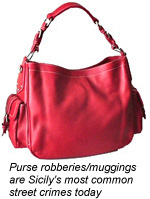
 You might
begin with our
You might
begin with our