...Best of Sicily presents... Best of Sicily Magazine. ... Dedicated to Sicilian art, culture, history, people, places and all things Sicilian. |
 |
by Vincenzo Salerno | ||
|
|
|
Magazine Index Best of Sicily Arts & Culture Fashion Food & Wine History & Society About Us Travel Faqs Contact Map of Sicily
|
|
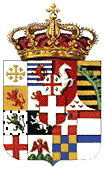
Their origins were military and feudal: knightly. Emerging in France's Savoy region in the eleventh century, where they eventually built a fortress at Chambery, the Savoy family rose to prominence as guardians of strategically important Alpine passes. Originally "French" in orientation and culture, they "Italianised" their ambitions with establishment of their capital at Turin in the sixteenth century and adoption of Italian as their realm's official language. Yet as recently as the nineteenth century many of their subjects, including the statesman Camillo Benso of Cavour, spoke French as their first language; there is also a Piedmontese dialect influenced by both tongues. The complete coat of arms of the House of Savoy (shown at left) reflects the dominions they ruled, some by pretension, or the dynasties from which they are descended. By the nineteenth century, they displayed only the white cross on a red field shown in the center of this design. In the Middle Ages, among Germanic emperors, French knights and Papal intriguers, nobody could have foretold the fortunes of the Savoy family. This relatively obscure house, possibly descended from Burgundian knights, would display over the centuries a machiavellian shrewdness and enduring strength of will. Traced through the male line, the Savoy sovereigns of the Kingdom of Italy descended directly from antecedents who ruled with sovereign authority before the Norman conquests of Hastings in the North and Messina in the South, who counted among their eleventh-century contemporaries not only the Normans William the Conqueror of England and Roger of Sicily, but Harald Sigurdson in Denmark, Alexius Comnenus at Constantinople and El Cid in Spain. Like so many other royal families, the Savoys were not destined by any divine authority to rule. There were to be no prophet Samuels or Pope Leos to anoint the founder of the dynasty. The progenitor of the House of Savoy was a certain Humbert (Umberto) "the Whitehanded" who lived from circa 980 until around 1047. He may have been the great-grandson of the Holy Roman Emperor Otto II, though this is unproven. In 1003, perhaps as as an act of gratitude for military service rendered to the later Emperor Conrad II, Humbert acquired certain Alpine territories as a feudal lord and came to be known as Count of Savoy. He appears to have already had certain lands, however, and from an early date, Humbert's de facto exercise of his rights was more akin to that of a sovereign ruler than to that of a mere feudal vassal. This could have resulted from the obvious importance of his loyalty to the Emperor, who may have considered that a "sovereign" ally with a vested interest in defending his own strategic lands would be more loyal than a temporal feudatory. Count Humbert may have had white hands from the Alpine chill of many a long winter's hunt for ibex and deer, but in fact his nickname, ascribed retroactively, derives from from a textual mistranslation of an early Latin record which actually refers to the walls of his castle, not his hands, as white. The dynasty's initial acquisition of territory was slow, at first based on advantageous marriages to Italian and French heiresses, but the Savoys' prominence came quickly. Two of Humbert's sons were bishops who served as provosts of the Abbey of Saint Maurice on the River Rhone east of Geneva, a church still associated with the Royal Family today. (Saint Maurice, the early Roman martyr whose relics are kept there, is the patron of the House of Savoy and of one of its orders of chivalry.) Amedeo (Amadeus) "the Tail," Humbert's oldest surviving son, succeeded his father but served as Head of the house for just a few short years before his own death. His nickname is attributed to the story that he was kindly disposed to pay a visit to the Pope and the Holy Roman Emperor, but not without his entourage of vassals and knights, his "tail." A younger son, Otto, who had married Adelaide of Turin, succeeded Amedeo around 1052.
Over the centuries, the dynasty would not be given to spectacular conquests, but rather to the slow, cautious, even plodding, increment of territory and influence. For more than three centuries, the title "Count of Savoy" was handed down from generation to generation, sometimes passing between collaterals but always in the hands of the Whitehanded's progeny. Territorial expansion accompanied the dynasty's history. Amedeo VI, called "the Green Count" for the colour he favored, which was the tincture of the liveries he gave to those who attended his tournaments, founded the Order of the Collar in 1362. Known today as the Order of the Annunciation, it survives as one of the oldest dynastic orders of chivalry. The family fortunes continued after the Middle Ages but would not survive the political complexities of the twentieth century. For a few centuries, the Savoys were keepers and protectors of the Shroud of Turin, usually - if not always - demonstrating a tolerance of Jews and Waldensians (early Protestants) rarely known elsewhere in Italy. The horrors of the Inquisition were minimized in Piedmont, Savoy and Aosta, where a number of Jews were ennobled. For all this, the Savoys today may be the most unfortunate royal family in Europe, compromised by their support of a particularly evil regime (Fascism) which eventually provoked war at home and abroad, and the Allied bombardment of Italy's cities. To add insult to injury, most Sicilians and other "southerners" regard "our" royal family to be the Bourbons who ruled until 1860 - defeated by the Savoys' supporters (Giuseppe Garibaldi comes to mind). Yet the Savoys have an assured place in Sicilian history. Indeed, it was in Sicily that they earned their right to be called kings, during the brief reign of Vittorio Amedeo II as King of Sicily from 1713 until 1718 when, after levying new taxes, he exchanged this realm for the Kingdom of Sardinia, taking most of the Sicilian treasury with him. Before the eighteenth century, the Savoys had been counts and then dukes and princes, albeit sovereign ones. Even before their alliance with Fascism, the Kingdom of Italy, the unitary state created in their name, could not be said to have been free or democratic, and poverty was rampant. The way Italy was united in this Risorgimento is now questioned by historians in Italy and abroad, though most oppose dividing the nation today. If we consider the period before the unification of Italy (1861), it is not true, as is often claimed, that the Statuto (constitution) of Carlo Alberto of Savoy was Italy's first constitution; that distinction must go to King Ferdinando I of the Two Sicilies (Naples and Sicily), the sovereign who granted the Sicilian Constitution of 1812 which unfortunately was rescinded a few years after it was effected. Acting in response not to empathy but to the violent riots of 1848, his grandson, Ferdinando II, granted a second constitution in Naples a few months before his cousin in Turin. Jurists generally agree that the enlightned but ephemeral Sicilian Constitution of 1812, formulated under British influences, would have been a far better basis for a democratic state that Carlo Alberto's Statuto. Until their deposition by referendum in 1946 (establishing the Italian Republic), the Savoys could be said to have reigned with sovereign authority, over one dominion or another, for almost a thousand years. The head of the dynasty and his heirs were actually exiled from 1946 until 2002, when a special act of parliament changed the constitutional law banning them from their own country. It has been said that people get the government they deserve. Sometimes they get the monarchy they deserve. King Umberto II, who died in exile in 1983, was different. Privately, Umberto was known to resent the Fascists, his wife even moreso. He was called "The May King" for having reigned briefly in that month in 1946 before the referendum, held during the Allied occupation. It was the first election in which Italian women could vote; only Fascists and Savoyard apologists ever asserted that the Kingdom of Italy was progressive. Umberto's only son, Prince Vittorio Emanuele, Duke of Savoy (shown below with his consort, Princess Marina), resides in Switzerland but visits Italy occasionally. He has a son, Emanuele Filiberto, who is married and has two daughters. If Italy still had a monarchy, Prince Vittorio Emanuele (Victor Emmanuel) would be its king - unless, of course, the Italians chose to change their dynasty. As King of Italy after 1861, Vittorio Emanuele II was reasonably efficient if not especially enlightened, and certainly no ideologue or philosopher. The referendum electing him with 98 percent of the vote was fraudulent, and pro-Bourbon riots continued in Palermo into the 1860s, but if pure democracy was lacking his governments at least managed to curb the Vatican's influence in Italian affairs. The Waldensian and Anglican churches in Palermo were built during this period, whereas previously the Bourbon government prohibited any but Catholic places of worship. In the vernacular of the nineteenth century, the Savoyard administration during the first three decades of the Kingdom of Italy was part of the so-called liberal movement, something of a misnomer. The new unitary state almost immediately confiscated church property, particularly monasteries and their estates, a policy which led to the closures of the accompanying Catholic schools which constituted the educational system of the former Two Sicilies. State schools were founded, for the most part, after 1910, and this delay hindered the growth of literacy in these regions for over fifty years. This is why, when the Allies arrived during World War II, they found higher illiteracy in southern Italy than in the north where more money had been allocated to train lay teachers and build schools as well as factories. Indeed, the situation throughout Italy was pitiful in 1943; agriculture was based on manual labor to harvest rice in Piedmont (mostly by women called mondine), maize in Lombardy and wheat in Sicily, while only a fraction of rural Italian homes had electricity or running water, with the situation worse in Sicily and most other southern regions.
The Kingdom of Italy was technically at war with the Vatican until 1929, and while this may have earned it a certain prestige in certain quarters (in Britain), it was of little help elsewhere. To this day, Italian leaders underestimate the influence of the Catholic Church only at their own peril. The Savoys should have signed the Lateran Treaties by 1900, perhaps during the reign of the devout Umberto I, murdered by an anarchist at the turn of the century. (Incidentally, the anarchist in question was Italian-born, not "American" as is sometimes claimed.) In the economic sphere southern Italy suffered terribly during Savoyard rule. Until 1860 Naples was the wealthiest city in Italy. By 1900 it was eclipsed by Milan, Turin and Rome. In 1860 Palermo was, by any standard, more prosperous than Turin, the Savoys' capital. The kindly Savoy monarchs of the nineteenth century were not personally responsible for this but, unfortunately, they seemed little concerned about what was done in their name. Much had changed since their ancestors had fought alongside Holy Roman Emperors and participated in Crusades. Truth be told, one is hard-pressed to think of many actual improvements to the nation or its people during the 86 years that the Savoys ruled a united Italy. Most of the industrial developments, such as the automobile, took place throughout western Europe and the Americas regardless of government. For the Sicilian Golden Age we must look to the thirteenth-century reign of Frederick II, not to the Savoys or Bourbons. While most Savoyard programmes or "reforms" were not much different, and neither better nor worse, than those initiated in other European countries during the nineteenth century, the colonialist occupation of Libya and the Italian military defeat at Adwa in Ethiopia in 1896 reflected particularly disastrous foreign policy decisions based on simple expansionism. The latter earned the Italian army a disdain that followed it through two World Wars and to some degree persists to this day. A second Ethiopian debacle in the 1930s only confirmed that widespread impression. Frankly, it would be merciful not to dwell on Italy's mediocre military escapades from 1861 until 1945. At home, hunger and poverty were by no means alleviated by Savoyard or Fascist policies. Beginning about 1870, millions of Italians fled Italy in search of a better life in the Americas, creating an Italian diaspora. Until that time, most emigration was from the relatively impoverished north, but Italian social, ecomonic and educational policies created greater poverty in the south, and in the event the steamship made it easier to leave Italy. In 1860 illiteracy was uniformly disgraceful throughout Italy (around 80%), but by 1920 it was comparatively worse south of Rome, partly because of the lack of schools, as we've already noted. As recently as 1950 most Italians resided outside the major cities and were involved in some way with agriculture (still rice and livestock in Piedmont, maize and dairy farms in Lombardy, durum wheat and olives in Sicily). Sadly, emigration continued. Australia, Argentina and even Germany and the United Kingdom have large Italian populations descended from immigrants who arrived in the decades following the end of the Second World War. Italy's "economic miracle" began in the 1950s, with a boost from the Marshall Plan, after the Savoys were gone. No doubt can exist that Vittorio Emanuele III was gravely mistaken in signing the Fascists' anti-Semitism laws, accepting the Ethiopian crown (restored to Haile Selassie backed by British force in 1941) and declaring war on the Allies. He was, however, at least nominally, a "constitutional" monarch with little real choice in matters of government. Long before the rise of Mussolini, many of the worst "Savoyard" policies were, in reality, instituted by mediocre ministers such as Cavour and the bigamist Crispi rather than the kings themselves, and yet the king, who embodies his nation, is ultimately responsible for these policies - whether they provoke the deaths of children in Ethiopia (with mustard gas) or the persecution of Jews in Italy. Despite his poor judgement, the long-reigning Vittorio Emanuele III was a reasonably intelligent man, according to those who met him (including American military officers in 1944), his son Umberto moreso. He did, in fact, remove Mussolini in the Summer of 1943, though he was prompted to do so by the Allied conquest of Sicily. The "civil war" that began later that year between Partisans and Fascists created social and political divisions that plague Italy to this day. There was talk of permitting Umberto, an officer in the air force (Italy's only competent service) to lead troops against the Germans and Mussolini's Republic of Salò. Had this materialized, the monarchy, defeated by a narrow margin following the war, might have been preserved. Neither event would come to be. The mode of Italy's unification, as well as its rabid historical revisionism, is increasingly disparaged by Italians of every regional and political color. That said, the government employees who organized the subdued celebrations marking 150 years of unification in 2011 - amidst an economic recession that was terrible even by Italian standards - did their best to focus on the Risorgimento without mentioning the Savoys. That ridiculous strategy only added to a general cynicism about the entire commemoration. Nevertheless, fewer than one percent of Italians are monarchists, and many people in Italy who know next to nothing about Italian history since 1900 despise the dynasty anyway. Rightly or wrongly, the House of Savoy has become the object of most of the Italians' venomous resentment of the effects of Fascism and the Second World War, even if virtually every family in Italy has a nonno or ageing papà who participated, usually without question, in Italian politics at home or the nation's misadventures (and perhaps the occasional atrocity) in Libya, Ethiopia, Greece, Albania, Croatia, Slovenia and Serbia. The rest of the world laughs at the ridiculous figure of the incompetent Fascist soldier, always mightier in the face of Balkan or African civilians than when facing British or American adversaries. Many older Italians harbour memories of lost loved ones and bombed cities. It's a heavy weight to be borne by a single family, even a royal one. Harassed by journalists a few years ago, Vittorio Emanuele's son responded with annoyance that, "I can't be held accountable for the actions of Garibaldi and Cavour!" That is true, but (more generally) it is also true that aristocrats presume to inherit their ancestors' prestige without inheriting their guilt, and the sword of hereditary principle has two edges. That Vittorio Emanuele's position as head of his dynasty is now contested by a cousin seems to reflect the typical jealousy of Italian families, where it is perfectly normal - almost expected - for siblings to fight over inherited property, even if it's just a one-car garage. This is not to suggest that the Savoyard patrimony is worth no more that a garage, but the family no longer owns any castles and the "value" of titles held by non-regnant royals and unrecognized nobles (like Italy's) are of less importance nowadays that the kings and queens are gone than they were a half-century ago.
During the Allied occupation of Palermo, Stefania Mantegna, Princess of Gangi, who held her title in her own right (not through her husband), gave Palermo's last lavish ball at her palatial residence in a time when there were food riots elsewhere in town. Attending were local aristocrats anxious to befriend the influential foreign guests, namely the British and American military officers attached to the Allied military government. That half of Italy was still at war with the Allies made no difference at all. Four decades later, when The Queen and Prince Philip were house guests at Palazzo Gangi, the Kings of Italy were little more than a faded memory. The Savoys are one of "our" royal families, if non-reigning, and such an ancient dynasty deserves at least to be remembered, if not with nostalgia or affection, then perhaps in the interest of the eternal Italian hope that tomorrow will be a better day. The definitive history of the Savoy reign and the kings' roles in Italian events after 1860 is Denis Mack Smith's Italy and Its Monarchy. The author was knighted by the Italian government for his various books dealing with Italian history. A slightly cynical, if accurate, work is Robert Katz's Fall of the House of Savoy. In Italian the most detailed, most objective history of the dynasty over the centuries is Francesco Cognasso's I Savoia. About the Author: Palermo native Vincenzo Salerno has written biographies of several famous Sicilians, including Frederick II and Giuseppe di Lampedusa. Material by B. Di Bella is used by permission. |
Top of Page |

 Today they are best-known as the former ruling family of Italy and patrons of the
nation's controversial
Today they are best-known as the former ruling family of Italy and patrons of the
nation's controversial 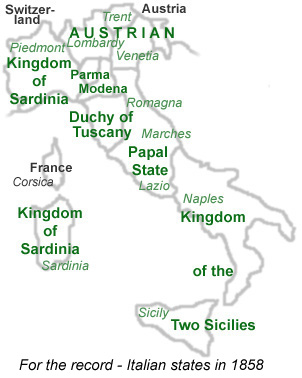 It was
Otto's own son, Amedeo, who established the dynasty's
presence in Piedmont (shown in the northwestern corner of Italy in this map),
inherited from his mother, Adelaide. As its name implies, Piedmont lies
at the "foot of the mountains." At this early date, the family
also ruled Aosta, which borders Switzerland and France.
It was
Otto's own son, Amedeo, who established the dynasty's
presence in Piedmont (shown in the northwestern corner of Italy in this map),
inherited from his mother, Adelaide. As its name implies, Piedmont lies
at the "foot of the mountains." At this early date, the family
also ruled Aosta, which borders Switzerland and France.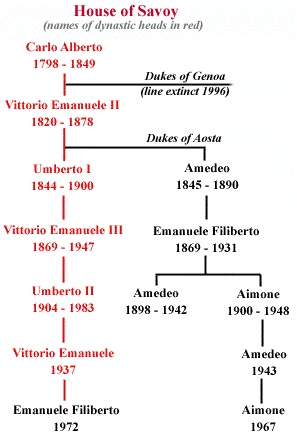 For many years the unification of Italy, the Risorgimento,
was enshrined as one of the great achievements of the House of Savoy,
but Italy's new federalism (regionalism) contradicts this, and it was Umberto
II who (as viceroy during the Allied occupation) signed the decree establishing
Sicilian autonomy. The Italian unification wars around 1860 were
probably unnecessary; Germany united herself as a federation with no need for this
kind of bloodshed.
For many years the unification of Italy, the Risorgimento,
was enshrined as one of the great achievements of the House of Savoy,
but Italy's new federalism (regionalism) contradicts this, and it was Umberto
II who (as viceroy during the Allied occupation) signed the decree establishing
Sicilian autonomy. The Italian unification wars around 1860 were
probably unnecessary; Germany united herself as a federation with no need for this
kind of bloodshed.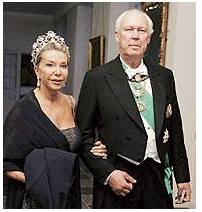 That the living Savoys,
like other non-reigning royalty (including the
That the living Savoys,
like other non-reigning royalty (including the