


|
|
|
|
|
|
|
Home Page Site Search Sights & Activities Localities • Places Good Travel Faqs Sicily's Top 12 Hotels • Planning Maps of Sicily Weather • Climate Nature • History • People Food • Wine • Dining Arts • Literature • Culture Monthly Magazine Sicilian Identity Sicily Links Contact • Follow
|
Meet the Real Sicilians
But it's still an island. The people of Crete, Malta and Cuba are islanders too and, strictly speaking, so are the Irish, the Japanese and even the Australians. The fact of Sicily being an island has often been cited in explanation of many traits habitually ascribed to her people. Some of the old clichés may even contain a morsel or two of truth, but unlike the inhabitants of smaller islands - even Corsica and Cyprus - until the twentieth century a Sicilian could very well live in Sicily without ever having to acknowledge that the land of his birth was, in fact, an island, if barely (the Strait of Messina not being very wide either physically or socially). Indeed, it is not altogether unusual, even today, to meet Sicilians who have never wandered very far from Italy. Sicily is fairly large, to be sure, and for centuries it was a nation unto itself. When you're standing atop the towers of its Lombard castle, the view from the mountaintop town of Enna seems just as isolated as Potenza, in the Italian peninsular region of Basilicata. So perhaps quoting the historical fact of successive conquests and invasions as an explanation for the Sicilian temperament is not really a sufficient explanation at all. Until the introduction of serious public education about a century ago, most Sicilians had, at best, a vague notion that they might be descended from the Arabs, Byzantines or Normans who ruled Sicily, even though the Sicilian language bears traces of the tongues of these peoples. Historical awareness is one thing, day-to-day experience quite another. Perhaps the idea of Sicilians' collective "race memory" of conquest by these civilisations has been slightly overstated. Is there such a thing as Sicilianità, Sicilian-ness? That's a very good question. There exists an obscure urban social art sometimes called sicilianismo which involves men affecting a certain type of heavy, gutteral accent when speaking Sicilian, using arcane gestures, wearing lots of gold and generally attempting to impress others of their (self-perceived) sexist importance. The cafone. The adjective sicula was coined by Sicilians to describe comparatively poorly-educated women who conform to the stereotype of the vastasa or cafona. Another word used to describe such women is giuseppina (Josephine), actually a given name once very common among Sicilians. This pseudo-eponym is similar the Italian-American guido (Guy), distant kin of the native Italian cafone. Better-educated Sicilians aspire to be more cosmopolitan than this - perhaps studying English in a serious way (it is now taught to Italy's youngest students) and aspiring to a career beyond that of a velina, as Italy's beach beauties and show girls (aspiring actresses) are known. Though underrepresented, Sicily's professional women deplore every palermitanata, as the lifestyles, chaos and urban problems of Palermo are called. A few years ago Tobias Jones wrote insightfully about these kind of phenomena in his bestseller, The Dark Heart of Italy. If you spoke Italian and lived in Sicily for, say, two or three years, you would meet all kinds of people, even if everybody you met was born and raised and educated here in Sicily. From this experience you might be able to draw a few generalisations but few solid conclusions. You might find that for every case of babbismo or mammismo (adult children well into their 30s emotionally and financially dependent on a father or mother) there was a slightly less obvious case at the opposite extreme - perhaps even somebody whose father or mother had all but ignored her in youth. Whatever one thinks of traditional social norms, about one in five (20%) of Sicilian births are outside marriage, part of a European trend. There is also the matter of physical appearances. You would find that there are many Sicilians with brown hair and dark eyes but a significant number having red or blondish hair and blue eyes - albeit rather few with extremely light blonde locks. Fashion is fickle and highly individualistic, even among young people. And black and white aren't the only colours people wear. Leaving aside the more obvious physical traits, for Sicilians themselves refer to dark-haired girls as more ("Moors") and redheads as normanne ("Normans"), you might notice a general dearth of better-educated people in certain professional fields; the "brain drain" is a Sicilian reality. There are precious few high-tech firms in Sicily and the island's mediocre universities don't do a great deal of scientific research. However, there is no shortage of historians and archaeologists. Here in Sicily, where tour guides are highly-educated, some guides' knowledge of Sicilian history is comparable to what you might expect of university history professors. You might also observe that an inordinate number of people simply do not seem very educated at all, premature school-leaving (long before the age of eighteen) being another unfortunate reality, especially among the so-called popolino. Statistically, Italians read fewer books per capita than the people of any European Union nation except Greece. You might meet a handful of seemingly unscrupulous Sicilians, but also a few who are paragons of the integrity and honour so rare in the modern world. For every Cagliostro and Provenzano there's a Dolci and a Falcone. You'd meet many women who know how to cook, and quite a few who don't! Most Sicilians are hospitable people. If a Sicilian offers you an espresso, he does so because he really wants to, not out of blind conformity to social convention. Yet most Sicilians, like most other Italians, are quite conformist when it comes to things like the "obligation" to give one's daughter a big wedding, perhaps going into debt to do so. This reflects the quest to put forward the bella figura, a good impression. In Sicily individualism is too often an illusion. Families can be a welcome source of support but are often more overbearing than what most of us would desire. Independence, a goal for most twentysomethings, is extremely difficult to achieve in Sicily. Would you want to live with your mother and father until you were thirty years old or married? While most live with parents out of social convenience, there's an economic reason too: Unemployment hovers around 30%, and 40% for "young" people (under 40). Still, There's even a rhyming expression to describe familial complexities: Parenti serpenti! (Relatives are snakes.) "When two Italians enter a room, they walk out with four opinions." This saying reflects more than mere ambivalence. The more animated conversations among Sicilians often seem to focus on political or "social" matters. In fact, the underlying issues are usually in some way economic or financial. While some Italians debate politics for its own sake, many more are interested because of the jobs or other benefits to be gained if a certain political party comes to power locally. It's that simple. If you find yourself in a large city at the right (or wrong) moment, you might encounter a street protest against unpopular political - and economic - policies. Unemployment and nepotism are very real problems, and each has altered Sicilian perceptions of life in Sicily, even among younger people. During your time here in Sicily at least a few of your preconceptions would almost certainly be shattered, in a rising proportion as you met ever younger people. No society is truly stagnant. While the majority of Sicilians may not be "practicing" Catholics, the Catholic Church remains a very strong cultural point of reference for most islanders - even for atheists. You don't have to be Catholic to enjoy the week-long public festivals for Saint Rosalie (in Palermo), Saint Agatha (in Catania) or Saint Lucy (in Siracusa). However, there is an increasing number of new immigrants in Sicily, and with them come new ideas. You might discover that Sicilians are generally engaging with strangers, if perhaps a bit guarded in some respects. Yes, it's an obvious contradiction - but not the only one you'll find in Sicily. Organised crime exists, woven invisibly into the complex fabric of society. You won't actually see it. It has become that subtle, yet there are business owners willing to fight against extortion. Today political corruption, the theft of public money, is just as prevalent, though the two phenomena are often connected. Does climate shape the mentality of an entire people? Sicily is usually warm and sunny, while England is cool and rainy. Are the Sicilians cheerful and the English dour? You be the judge. It has been said there are two Sicilies, and that the easterners are more cheerful than the westerners, yet the east usually gets more rain. This question of personalities, of an island divided, cannot be proven scientifically.
Some vestiges of traditional life remain, especially in the country: the street markets, the religious festivals, the late-afternoon strolls (passeggiata), the long lunches and afternoon shop closings (from 1 to 4), the ever-vanishing rustic wedding engagements. Until around 1960 the majority of Italians lived in rural or semi-rural areas. The provinces of Catania and Palermo each boast around a million residents, while smaller cities like Messina, Trapani, Agrigento and Siracusa are quite populous. Except for Sicily's three or four largest urban centers, the "country" is never very far away - though near the cities it may not be too scenic. Precisely because the subject of the Sicilian personality is an eclectic one, at the end of your three years in Sicily your own observations might be entirely different from everything you've just read here. Which proves our point about Sicilians' surprising diversity of character. One thing we'd probably agree on, though, is that it's the people - not just the sights - that make a place special. The much abused word unique is perfectly suitable in describing the people of Sicily. The question of a precise Sicilian identity is still more complex. On this site there are literally dozens of articles about life in Sicily. There are also several books based on their authors' personal experiences that we recommend which are distinguished for their perspective, having been written by insightful people who actually live in Sicily but were raised elsewhere. |
|||
Top of Page |


 "What are the people like?" It's one
the first questions most of us ask before visiting a destination that's new to us. Sicilians are isolani.
In any language, the rather generic word islanders connotes all kinds of things.
Sicily is a very special island, if hardly the only one with its own personality (Ireland, Malta and Sardinia come to mind),
and less isolated than most. But Sicily's people, the real Sicilians you'll meet on this island,
elude simple definitions or even descriptions. The persistent
"What are the people like?" It's one
the first questions most of us ask before visiting a destination that's new to us. Sicilians are isolani.
In any language, the rather generic word islanders connotes all kinds of things.
Sicily is a very special island, if hardly the only one with its own personality (Ireland, Malta and Sardinia come to mind),
and less isolated than most. But Sicily's people, the real Sicilians you'll meet on this island,
elude simple definitions or even descriptions. The persistent 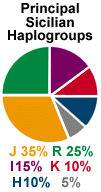 However, as an aside, we should mention that science has proven that, indeed, Sicilians are
a living example of
However, as an aside, we should mention that science has proven that, indeed, Sicilians are
a living example of